
Why do coil wraps matter for your shop?
If you've worked the counter long enough, you've had the same conversation a hundred times. Someone walks in with a rebuildable tank, holds up a spool of wire, and asks, "How many wraps should I do?" The honest answer is: it depends on what ohms you're chasing, and that depends on your device's power range.
For e-commerce operators, the stakes are a bit different. You're not just helping one customer; you're writing product listings, answering support tickets, and maybe even building sample coils for photos. If you can explain wraps in plain terms, you'll save yourself a lot of back-and-forth.
Let's break down the myths first, then I'll point you to a tool that does the heavy lifting.
Myth stack 1: More wraps always equals more vapor
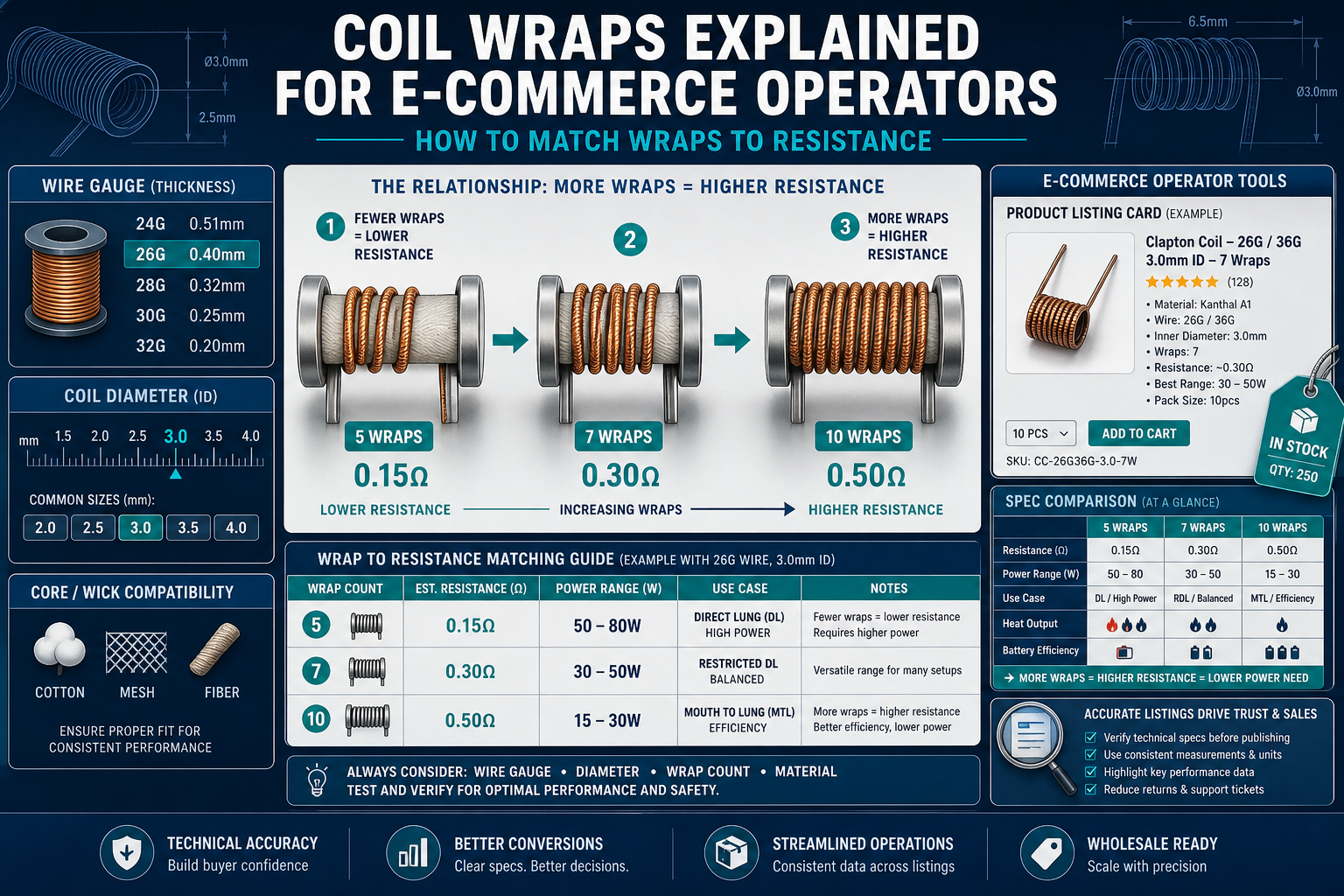
You'd think that more wire touching the wick means more heat and more vapor, right? Not exactly. More wraps do increase resistance, which means your coil heats up slower and needs more wattage to reach the same temperature. If your device tops out at, say, 50W, a high-resistance build with lots of wraps might feel weak. You'll get thin vapor and long ramp-up.
Instead of chasing a wrap count, think about the target resistance. A single coil at 0.5 ohms might give you a satisfying hit at 40W. To get there, you might need 6 wraps of 24-gauge kanthal, but only 4 wraps of a thicker wire. The number of wraps is just a means to an end.
Myth stack 2: Thicker wire always means lower resistance
It's true that thicker wire (lower gauge) has less resistance per foot. But that doesn't mean you always get a low-ohm build. If you wrap a thick wire around a small inner diameter, you might end up with a coil that's too long to fit in your deck, or one that reads higher than you expected because of the added length.
Here's a practical example: a 26-gauge kanthal wire at 3mm inner diameter, 5 wraps, gives you around 0.8 ohms. If you switch to 24-gauge, same wraps and diameter, you'd drop to about 0.5 ohms. But if you add two more wraps to that 24-gauge, you're back up to 0.7. The wire gauge and wrap count interact—you can't change one without considering the other.
Myth stack 3: You can't trust calculator results; you have to test on a meter
Some old-school builders swear by the ohm meter and refuse to trust a calculator. I get it, but the math behind coil resistance is well-established. The Windbar Coil Resistance Calculator uses the standard formula that accounts for wire material, gauge, inner diameter, and wrap count. It's not a guess; it's physics.
That said, you should still verify with a meter after you build. Wraps can loosen or overlap, and the posts might not be tightened perfectly. A calculator gets you in the ballpark; a meter confirms the pitch. For a shop operator, being able to pre-calculate a build before you even wrap it is a huge time-saver.
Myth stack 4: All wire materials behave the same
Kanthal, nichrome, and stainless steel all have different resistance characteristics. Stainless steel, for example, changes resistance as it heats, which is why it's used in temperature control. Nichrome has a different resistivity than kanthal, so the same wrap count will give you a different ohm reading.
If you're listing coils on your site, you need to specify the material, gauge, and wrap count so customers know what they're getting. Saying "0.3 ohm coil" isn't enough if you don't mention it's a 3mm ID, 6-wrap kanthal build. That level of detail builds trust and reduces returns.
The pattern behind the myths
The common thread here is that wrap count is only one variable. Resistance depends on wire material, wire gauge, inner diameter, and the number of wraps. Change any one, and your target ohms shift. That's why I always recommend using a calculator before you build or list a product.
Here's a quick workflow you can use:
- Decide your target resistance (check your device's recommended range).
- Pick the wire material and gauge you have in stock.
- Choose an inner diameter that fits your deck.
- Use the calculator to see how many wraps you need.
- Build, meter it, and adjust if needed.
For e-commerce, this means you can accurately describe your coils in listings. For customers, it means fewer surprises when their new coil reads 0.8 ohms instead of 0.5.
Before you go, check out our guide on nicotine salts vs. freebase to understand how coil choice affects the overall vaping experience—it's all connected.
And if you're ready to get exact numbers, use the Coil Resistance Calculator. You'll have your wraps dialed in before you even touch the wire.
If you run into a build that doesn't match the calculator, the Windbar community is a good place to troubleshoot. There's always someone who's built with the same wire and can tell you what to tweak.
FAQ
Does more wraps always mean more resistance?
Yes, for the same wire and inner diameter, adding wraps increases resistance because you're adding more wire length. But if you change wire material or gauge, the relationship shifts. A thicker wire (lower gauge) has less resistance per inch, so you might need more wraps to hit the same ohms.
How do I know what resistance to build for my vape?
Check your device's wattage range and the recommended resistance printed on the tank or mod. A regulated mod can handle a range, but staying within the recommended range gives the best flavor and coil life. For a quick check, use the Coil Resistance Calculator to see what your build will land at.
Sources & Further Reading
- FDA on ENDS products: https://www.fda.gov/tobacco-products/products-ingredients-components/vaporizers-e-cigarettes-and-other-electronic-nicotine-delivery-systems-ends
- Related: What to Look for in Coil Type Before Buying a Disposable Vape
- Related: Mesh Coils vs Standard Coils for Weekend Users
Myth pattern
- More wraps = higher resistance; fewer wraps = lower resistance.
- Wire material and gauge affect resistance more than wrap count alone.
- Use a coil resistance calculator to translate wraps into ohms for your listings.
- Match resistance to your device's power range to avoid weak hits or overheating.
In this topic cluster
- Nicotine Strength articles
- Nicotine Salts vs. Freebase for Premium Vapers: Which Delivers the Better Experience?
- Photo Asset Planning for Vape Product Pages: What You Need Before Launch
- Color, Pattern, and Finish Systems: Designing a Coherent Vape Product Line
Related Windbar Resources
- Coil Resistance Calculator — Turn your wrap count into an exact ohm reading.