
Why mg/ml matters more than you think
When you pick up a vape bottle or disposable, the nicotine strength is almost always printed as a number followed by mg/ml. If you're new to vaping, that number might as well be in a foreign language. But it's actually simple: it tells you how much nicotine is packed into each milliliter of liquid. And that number directly affects how your first few sessions feel—too high and you might get a harsh throat hit or a headache; too low and you'll be puffing constantly, wondering why it's not doing anything.
For most first-time buyers, the real problem isn't the math—it's that they don't know what strength matches their smoking history. So let's fix that.
What mg/ml actually means (in plain language)
Think of mg/ml like a concentration. A 10 ml bottle at 10 mg/ml has 100 mg of total nicotine. Double the strength to 20 mg/ml and the same bottle now has 200 mg. The number of puffs you take doesn't change the math—each puff delivers a certain amount based on the strength and your device's output.
Two things to know right now:
- Freebase nicotine is the older form. It's harsher at higher strengths, so you'll usually see it at 3, 6, or 12 mg/ml.
- Nicotine salts are smoother, which is why disposables can carry 20, 30, or even 50 mg/ml without feeling like sandpaper.
If you see a high number like 50 mg/ml on a disposable, it's almost certainly a salt. That's normal, but it doesn't mean you should start there.
How to choose your first strength (a simple starting point)
Your smoking habit is the best guide. Here's a rough map:
- Never smoked, or only occasionally? Start at 0 mg/ml or 3 mg/ml. You're vaping for the ritual, not the nicotine.
- Light smoker (under 10 a day): 10–15 mg/ml salt, or 6 mg/ml freebase.
- Moderate smoker (half a pack to a pack a day): 20–25 mg/ml salt.
- Heavy smoker (more than a pack a day): 30–50 mg/ml salt, but start at the lower end and adjust.
These are starting points, not rules. Your body will tell you if you overshot—usually a scratchy throat or a mild headache. That's a sign to step down, not to push through.
Don't skip the math: use the Windbar Nicotine Strength Calculator
You can guess, but why guess when you can be precise? The Windbar Nicotine Strength Calculator at /tools/nicotine-strength-calculator does the heavy lifting for you. Enter the mg/ml and bottle size, and it gives you the total nicotine per bottle, plus a rough comparison to your current habit. That's useful when you're staring at a shelf of options and every label looks the same.
It's also handy for comparing two bottles that look different but actually contain the same total nicotine. For example, a 10 ml at 20 mg/ml equals a 20 ml at 10 mg/ml—200 mg each. The calculator shows that in seconds.
What the number on the bottle doesn't tell you
Mg/ml is only half the story. How a vape feels depends on the device too. A higher-wattage device will vaporize more liquid per puff, so you get more nicotine per hit even at the same mg/ml. That's why a 10 mg/ml in a powerful mod can hit harder than a 20 mg/ml in a small disposable. If you're switching between device types, adjust your strength accordingly.
Also, check the label for 'nicotine by volume'—that's just another way of saying mg/ml. Some brands use one term, some use the other. Now you know they're the same thing.
Safety first: a quick note on handling
Nicotine is a chemical, and strong concentrations (especially salts) deserve respect. Keep bottles capped, store them away from kids and pets, and wash your hands if you spill. If a device leaks in your bag, don't charge it and don't vape it—dispose of the liquid and clean the device thoroughly. That's not paranoia; it's common sense.
The bottom line
Mg/ml doesn't have to be confusing. It's just a concentration label. Learn what it means, pick a starting strength based on your smoking history, and use the Windbar Nicotine Strength Calculator to double-check your math. That's all you need to make your first order confidently.
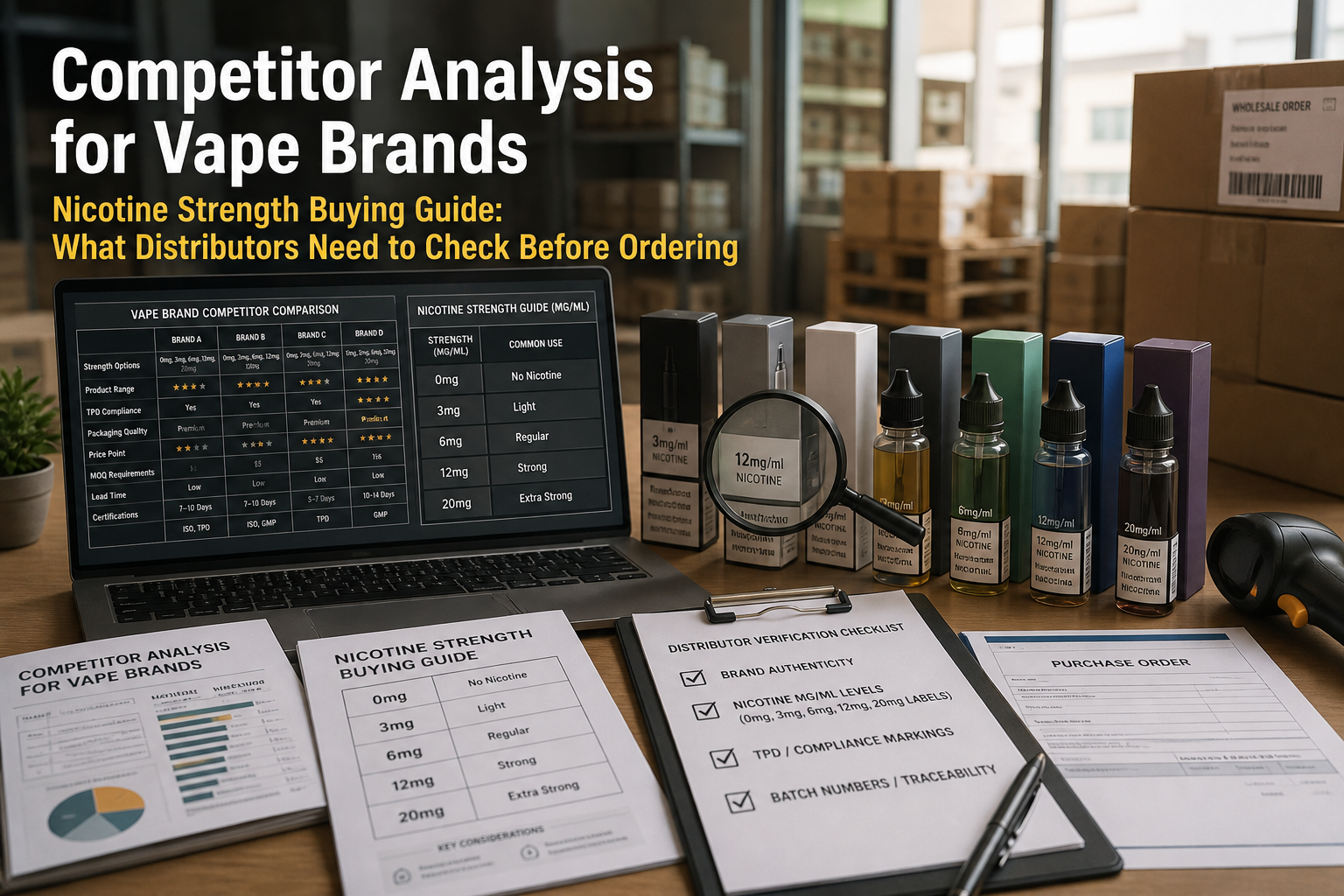
For more detail on how nicotine strengths affect your buying decisions, see our Nicotine Strength Buying Guide for Distributors or the Bottle Math Made Simple guide. If you're comparing devices and want to understand battery life, read our mAh Explained guide.
FAQ
Is higher mg/ml always stronger?
Yes, higher mg/ml means more nicotine per milliliter, so it's stronger. But how it feels also depends on whether it's freebase nicotine or nicotine salts. Salts are smoother, so a 50 mg/ml salt can feel less harsh than a 24 mg/ml freebase.
How do I choose my first nicotine strength?
Start with your smoking habit. If you smoked a pack a day, 20–30 mg/ml (salt) is a common starting point. Light smokers might start at 10–15 mg/ml. When in doubt, pick a lower strength—you can always go up.
What does 'nicotine by volume' mean?
It's another way to say mg/ml. On some labels, you'll see nicotine 'by volume' or 'per ml.' It's the same thing: milligrams per milliliter.
Sources & Further Reading
- FDA – Nicotine Strength in E-Liquids: https://www.fda.gov/tobacco-products/products-ingredients-components/nicotine
In this topic cluster
- Nicotine Strength articles
- mAh Explained for Vape Shop Owners: What It Means and How to Check It
- Bottle Math Made Simple: How to Calculate Nicotine Strengths for Your Vape Shop
- Nicotine Strength Buying Guide: What Distributors Need to Check Before Ordering
Related Windbar Guides
- Nicotine Strength Buying Guide: What Distributors Need to Check Before Ordering
- Bottle Math Made Simple: How to Calculate Nicotine Strengths for Your Vape Shop
Keep this for later
Create a free Windbar account to save your preferred nicotine strengths and revisit your calculator history next time you order.