
Note: setup
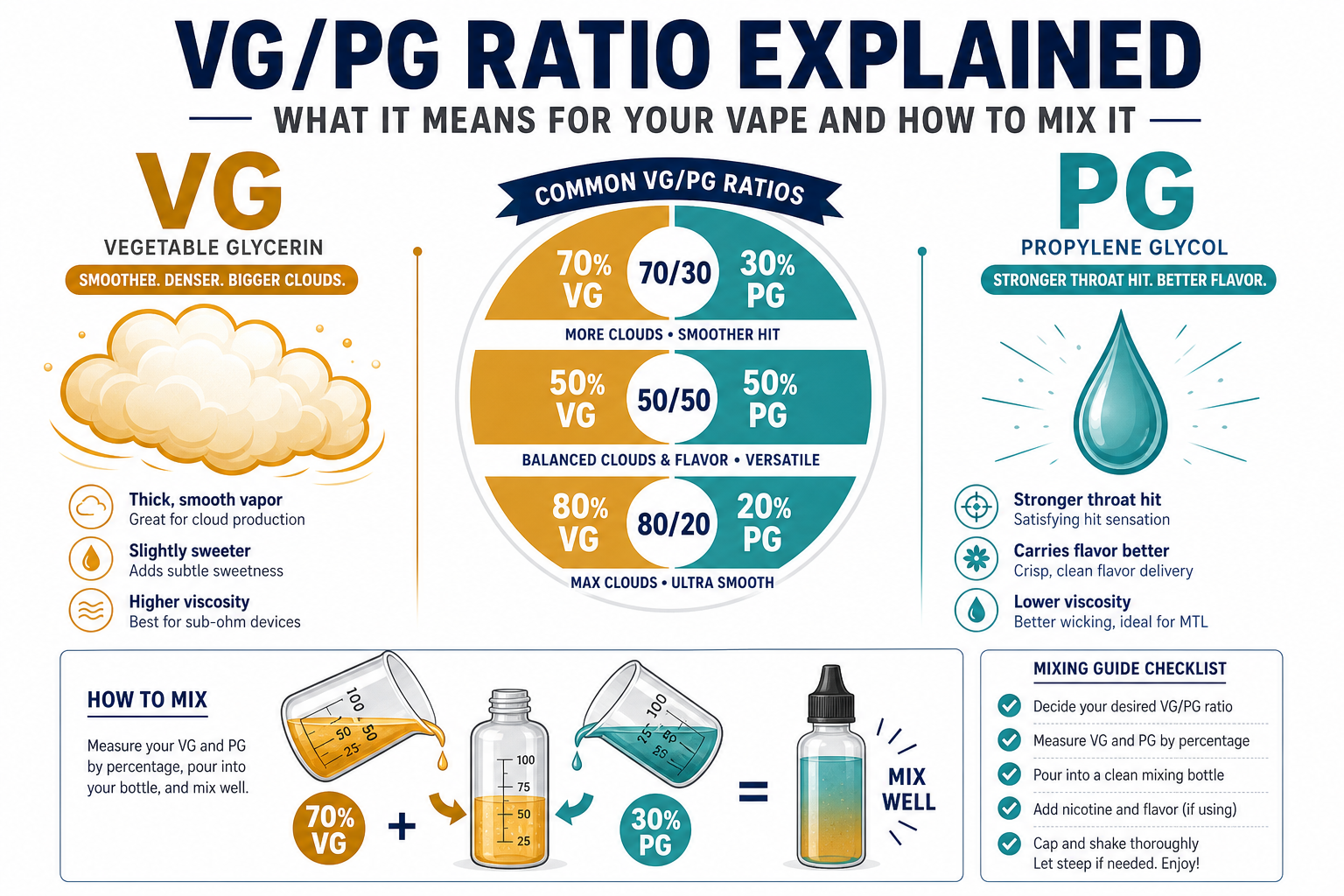
Let's start with what you're actually working with. VG (vegetable glycerin) is thick and sweet, and it's what makes those big clouds. PG (propylene glycol) is thinner, carries flavor better, and gives that sharp hit at the back of your throat that some people compare to smoking. They're almost always mixed together, and the ratio is simply the percentage of each.
A typical bottle might say 70/30, meaning 70% VG and 30% PG. That's a balanced spot that works well in most tanks. If you see 50/50, that's a classic ratio favored by pod users and people who want a stronger throat hit. And 80/20 or higher pushes toward cloud chasing, with a very airy inhale.
Your device matters too. Thick VG-heavy juice can struggle in small wicking ports, so if you're using a pod system, a 50/50 or 60/40 is usually safer. Sub-ohm tanks and RDA setups handle the thick stuff fine.
Note: daily friction
Here's where mixing your own e-liquid gets tricky. You've got VG, PG, nicotine base, and flavoring—each with its own volume. If you're not careful, you end up with something that's either too harsh, too weak, or just doesn't taste like you expected.
The most common mistake we see? People eyeball the amounts. A few extra ml of VG can thin out flavor and mute the throat hit. Too much PG and it gets harsh and can feel dry. The math isn't hard, but it's annoying to do by hand every time you want to tweak a batch.
That's the friction. You want to experiment, but the numbers get in the way. It's a perfect use case for a simple tool that does the math for you.
Note: what surprised us
What surprised us is how much a small shift in ratio changes the experience. Going from 70/30 to 60/40 might not sound like much, but it noticeably increases the throat hit and sharpens the flavor. For someone transitioning off cigarettes, that extra kick can be the difference between a satisfying vape and one that leaves you reaching for a smoke.
Also surprising: the sweetness. VG has a natural sweetness that can alter how your flavors come across. A high-VG mix can make a dessert flavor taste rounder and richer. A high-PG mix can make the same flavor taste crisper and more pronounced. So the ratio isn't just about clouds and throat—it's a flavor control knob too.
If you're curious to test this yourself, a 60/40 blend is a gentle step toward more throat hit without going full 50/50. For cloud chasers, 80/20 is a good middle ground between vapor and flavor.
Note: what we would change
If we had one complaint about the DIY scene, it's that people don't measure enough. We'd change the habit of mixing by feel. Even experienced mixers benefit from a consistent target ratio. Write down your recipe, note the VG/PG split, and stick to it until you intentionally change it.
And that's exactly what the Windbar E-liquid Mix Calculator is for. You punch in your target ratio, nicotine base strength, and bottle size—it tells you exactly how many ml of each ingredient to add. No guesswork, no wasted bottles.
Before you start mixing, double-check your nicotine base. If it's 100mg/ml, you'll need far less than a 50mg base. The calculator handles that, but it's worth understanding what you're working with. And always work in a well-ventilated area, wear gloves if you're handling high-strength nicotine, and keep everything away from kids and pets.
One more thing: if you're buying commercial e-liquid, the ratio is printed on the bottle. Pay attention to it, especially if you're switching devices. A high-VG juice in a low-power pod will be slow to wick and might taste burnt.
Field verdict
VG/PG ratio is one of those things that sounds technical but is really about your personal preference. Do you want huge clouds? Go high VG. Do you want a strong throat hit? Go higher PG. Do you want a middle ground? Start at 70/30 and adjust from there.
If you're mixing your own, don't do the math by hand. Use the Windbar E-liquid Mix Calculator to nail your ratio every time. It takes five seconds and saves you from a batch of juice that's too harsh or too weak.
The bottom line: know what the numbers mean, adjust to your taste, and measure carefully. That's the whole game.
FAQ
What does VG/PG ratio mean for me?
It's the mix of two base liquids in your e-liquid. VG (vegetable glycerin) makes thick vapor and feels smoother; PG (propylene glycol) gives a sharper throat hit and carries flavor better. The ratio changes how your vape feels and performs.
Which VG/PG ratio should I choose?
If you want balanced clouds and flavor, go 70/30. If you prefer a stronger throat hit like a cigarette, try 50/50. For maximum vapor, go 80/20 or higher VG. It also depends on your device—high VG is thicker, so it works best in sub-ohm tanks.
How do I mix my own e-liquid with the right VG/PG ratio?
Start with your target ratio, then use the Windbar E-liquid Mix Calculator. Enter your desired VG/PG split, nicotine base strength, and bottle size. It tells you exactly how many ml of each ingredient to add—no math headaches.
Sources & Further Reading
- FDA Tobacco Products: fda.gov/tobacco-products – Regulatory context for nicotine products.
- For more on nicotine types, see our guide on Nicotine Salts vs. Freebase.
- Looking for a deeper dive into the calculator? Read about WINDBAR e-liquid calculator.
Notes readers ask
Q: What does VG/PG ratio mean for me?
It's the mix of two base liquids in your e-liquid. VG (vegetable glycerin) makes thick vapor and feels smoother; PG (propylene glycol) gives a sharper throat hit and carries flavor better. The ratio changes how your vape feels and performs.
Q: Which VG/PG ratio should I choose?
If you want balanced clouds and flavor, go 70/30. If you prefer a stronger throat hit like a cigarette, try 50/50. For maximum vapor, go 80/20 or higher VG. It also depends on your device—high VG is thicker, so it works best in sub-ohm tanks.
Q: How do I mix my own e-liquid with the right VG/PG ratio?
Start with your target ratio, then use the Windbar E-liquid Mix Calculator. Enter your desired VG/PG split, nicotine base strength, and bottle size. It tells you exactly how many ml of each ingredient to add—no math headaches.