
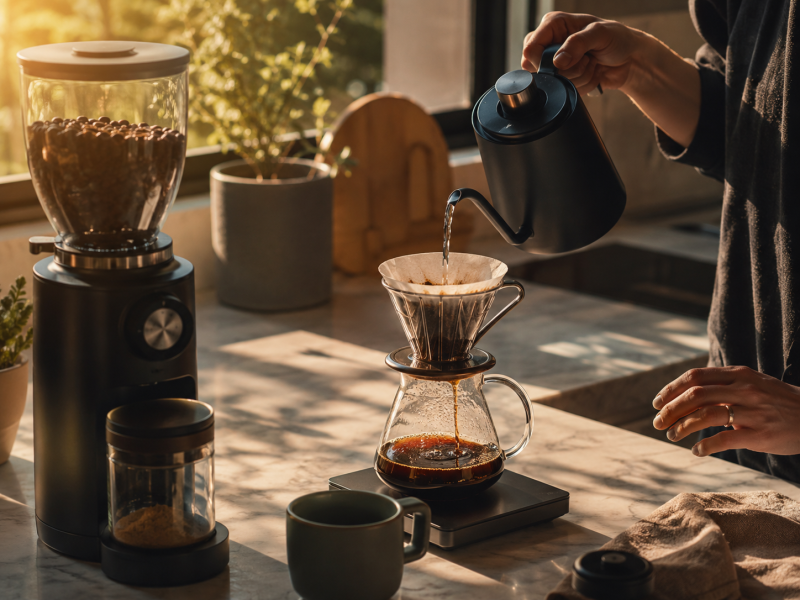
Spring pour-over: you don't need to start over
If you haven't brewed pour-over since last fall, here's the good news: you haven't forgotten as much as you think. The gear is still in the cupboard, the beans are probably stale, and the internet is full of advice that makes brewing sound like a chemistry exam. Let's clear that up.
The truth is, pour-over is forgiving. You don't need a fancy kettle, a $200 grinder, or a scale that measures to 0.1 grams. You need coffee, water, a filter, and a few minutes. Everything else is optimization, not necessity.
Myth #1: You must use a gooseneck kettle
The biggest myth in pour-over is that a gooseneck kettle is essential. It's not. A gooseneck gives you precision, sure, but a regular kettle or even a microwave-heated cup of water works fine. The secret is pouring slowly and in circles, not the shape of the spout.
If you're returning after a break, don't buy anything. Use what you have. If the water comes out in a gush, pour from higher up or use a spoon to break the flow. You'll get a decent cup.
Myth #2: Water temperature must be exactly 200°F
Some recipes obsess over 200°F or 93°C. The truth? Boiling water (212°F) is too hot, but anything between 195°F and 205°F works. If you don't have a thermometer, boil and wait 30 seconds. That's close enough.
What actually affects extraction more is grind size. If your coffee tastes bitter, it's usually too fine, not too hot. If it tastes sour, it's too coarse. Adjust the grind before you fuss over temperature.
Myth #3: You need a $50 bag of beans to get a good cup
Fresh beans matter, but expensive beans don't guarantee a good brew. A medium-roast from a local roaster, bought within the last two weeks, will beat a stale $50 bag every time. Look for a roast date on the bag—if there isn't one, the beans are probably old.
If your beans are stale, no technique will save them. That's the one thing you should replace before anything else.
What actually helps in real use
Here's what makes a noticeable difference, in order of importance:
- Fresh beans: Buy whole beans and grind them yourself if you can. Pre-ground is fine for a week, but after that, it goes flat.
- A consistent grind: You don't need a $300 grinder, but a burr grinder (even a hand one) beats a blade grinder. Aim for table salt texture.
- A scale (optional but nice): You can use a measuring cup, but a scale removes guesswork. Start with 1:16 ratio—30 grams of coffee to 480 grams of water.
- Clean gear: Old coffee oils go rancid. Rinse your brewer and carafe with hot water before you start.
That's it. No special kettles, no exotic water chemistry, no pour patterns that require a barista certificate.
How to sanity-check marketing claims
When you see a new brewer or gadget claiming to "unlock" flavor, ask two questions: Does it change the grind or the water flow? And is the price justified by the material, not the hype?
Most pour-over cones are just plastic, ceramic, or glass with a hole. Expensive versions use better materials or aesthetics, but they don't brew better coffee. The filter shape and your technique do the heavy lifting.
If a product claims to fix bitterness without changing your grind, it's probably marketing. Bitterness comes from over-extraction, which is a grind or time issue, not a brewer issue.
A quick checklist for your first brew back
Before you start, run through this:
- Coffee is fresh (roast date within 2–3 weeks).
- Grind is medium-fine, like table salt.
- Water is off the boil for 30 seconds.
- Ratio is roughly 1:16.
- You have a timer or just watch the clock on your phone.
If you follow that, you'll get a decent cup. Then tweak one variable at a time—grind, ratio, or pour speed—and see what changes. That's how you learn, not by buying more gear.
The bottom line
Pour-over after a break isn't a chore. It's a few minutes of ritual that rewards patience, not perfection. Ignore the gear snobs and the internet's obsession with precision. Use what you have, buy fresh beans, and adjust by taste. You'll be surprised how quickly it comes back.
This guide is for general brewing education. Individual tastes vary—experiment to find what you like.
Reality check
- Pour-over coffee doesn't require expensive gear or obsessive precision. The biggest wins come from fresh beans, a consistent grind, and a simple ratio. Most brewing myths—like the need for a gooseneck kettle or exact water temperature—are optional upgrades, not requirements.
- Fresh beans beat fancy gear every time.
- A 1:16 ratio (coffee to water) is a forgiving starting point.
- Grind size matters more than water temperature precision.
- You don't need a gooseneck kettle to make great pour-over.
Sources & Further Reading
- National Coffee Association — General coffee brewing guidelines and water ratio references.
Still confused about…
Q: Is a gooseneck kettle really necessary for pour-over?
No. It helps with control, but you can use a regular kettle or even a measuring cup with a spout. Pour gently and steadily—that's the real trick.
Q: What's the best coffee-to-water ratio for pour-over?
Start with 1:16—one gram of coffee for every 16 grams of water. That's about 30 grams of coffee for 480 grams of water (roughly 2 cups). Adjust to taste from there.
Q: How do I know if my grind is too fine or too coarse?
If the brew tastes bitter and takes forever, it's too fine. If it's sour and runs through fast, it's too coarse. Aim for table salt texture and adjust in small steps.