
Start with the basics
If your matcha feels like sand in your mouth, you're not imagining it. Budget culinary matcha is ground from larger leaves and often has a coarser grind, so gritty texture is common. But before you blame the powder and toss it, try a few simple fixes that cost nothing.
First, check your water temperature. If you're using boiling water, you're scorching the matcha and making it bitter and gritty. Let the water cool to about 160-175°F (70-80°C). No thermometer? Bring water to a boil, then wait a few minutes.
Second, sift your matcha. Use a fine-mesh strainer or a matcha sifter. Push the powder through with a spoon. This breaks up clumps and removes the largest particles that cause grit. It takes ten seconds and makes a real difference.
Medium detail: Whisking technique
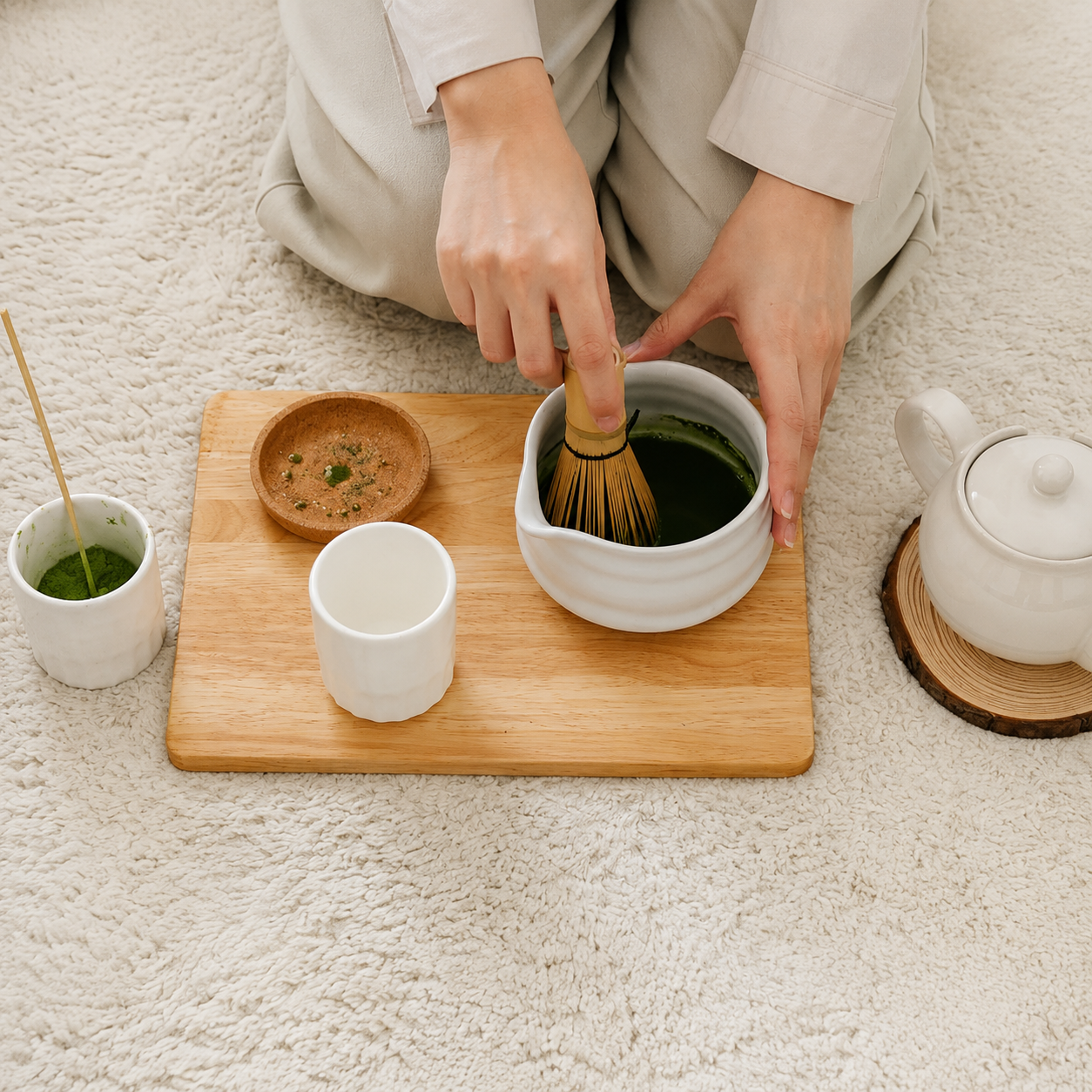
Now that you've sifted, the next step is whisking. The classic bamboo chasen is the best tool for the job. It has many tines that create a fine foam and suspend the powder evenly. If you don't have one, a small milk frother works too.
Here's the trick: don't just stir. Move the whisk in a zigzag motion, not in circles. This creates more turbulence and helps incorporate the powder. Whisk for 15-20 seconds until you see a fine foam on top.
If you're using a frother, pulse it in short bursts to avoid over-mixing, which can make the matcha clump.
One more tip: after whisking, let the matcha sit for about a minute. The coarser particles will sink to the bottom, leaving the smooth liquid on top. Drink slowly and stop before you reach the last sip if you want to avoid the gritty tail.
Fine detail: Adjust your ratio
Sometimes the problem is too much matcha. If you're using a heaping teaspoon per cup, that's a lot of powder. Try reducing to 1/2 to 1 teaspoon (about 2-3 grams) for 8 ounces of water. A stronger flavor doesn't require more powder—better whisking does.
Also, consider the liquid. Mixing matcha with milk or a milk alternative can mask grittiness because the fat coats the particles. If you're drinking it straight, that's when grit stands out.
If you're making a latte, add a splash of hot water to the matcha first, whisk until smooth, then add milk. This creates a paste that blends better.
Expert-only notes: Upgrade your technique, not your budget
You don't need to buy a $50 tin of ceremonial matcha to get a smooth cup. The techniques above will get you 80% of the way there. But if you want to go further, consider a few adjustments.
First, use a finer strainer. A regular kitchen sieve might not be fine enough. Look for a strainer with at least 60 mesh. A matcha sifter is even finer.
Second, try a different whisking surface. A wide, shallow bowl gives you more room to whisk and reduces clumping. A bowl with a flat bottom is ideal.
Third, consider your water quality. Hard water with high mineral content can affect the way matcha mixes. If your tap water is hard, try filtered water.
Finally, if you're making matcha for baking or cooking, gritty texture is less of an issue—it's already going into a batter. Save your smoothness tricks for drinking.
When to stop and just accept it
Here's the honest truth: if you've tried all of the above and your matcha is still gritty, it might be time to accept it. Budget culinary matcha has its limits. You're not doing anything wrong—the grind is just coarser.
That doesn't mean you can't enjoy it. Use it for cooking, baking, or making a smoothie where the texture is masked. And when you're ready to splurge, invest in a quality matcha that's stone-ground and labeled for drinking.
But for now, try sifting, whisking, and resting. You'll probably find your cup is much smoother—and you didn't spend a dime.
If you're mixing matcha with hot water, always let it cool first. Never drink water that's been boiling—it's a burn risk.
Sources & Further Reading
- Ippodo Tea Co. — A long-established Japanese tea shop with guides on matcha preparation.
- Matcha Source — Provides detailed articles on matcha grades and brewing techniques.
Ladder
- Gritty texture in budget culinary matcha often comes from larger leaf particles and a less refined grind. Simple fixes like sifting, using a whisk, and letting the matcha rest can dramatically improve texture without upgrading your stash. Focus on technique before spending more on premium grades.
- Sift your matcha before whisking to break up clumps and reduce grit.
- Use a bamboo whisk or a small milk frother for smoother mixing.
- Let the matcha settle for a minute after whisking—the finest particles stay suspended, while coarser ones sink.