
Ritual start
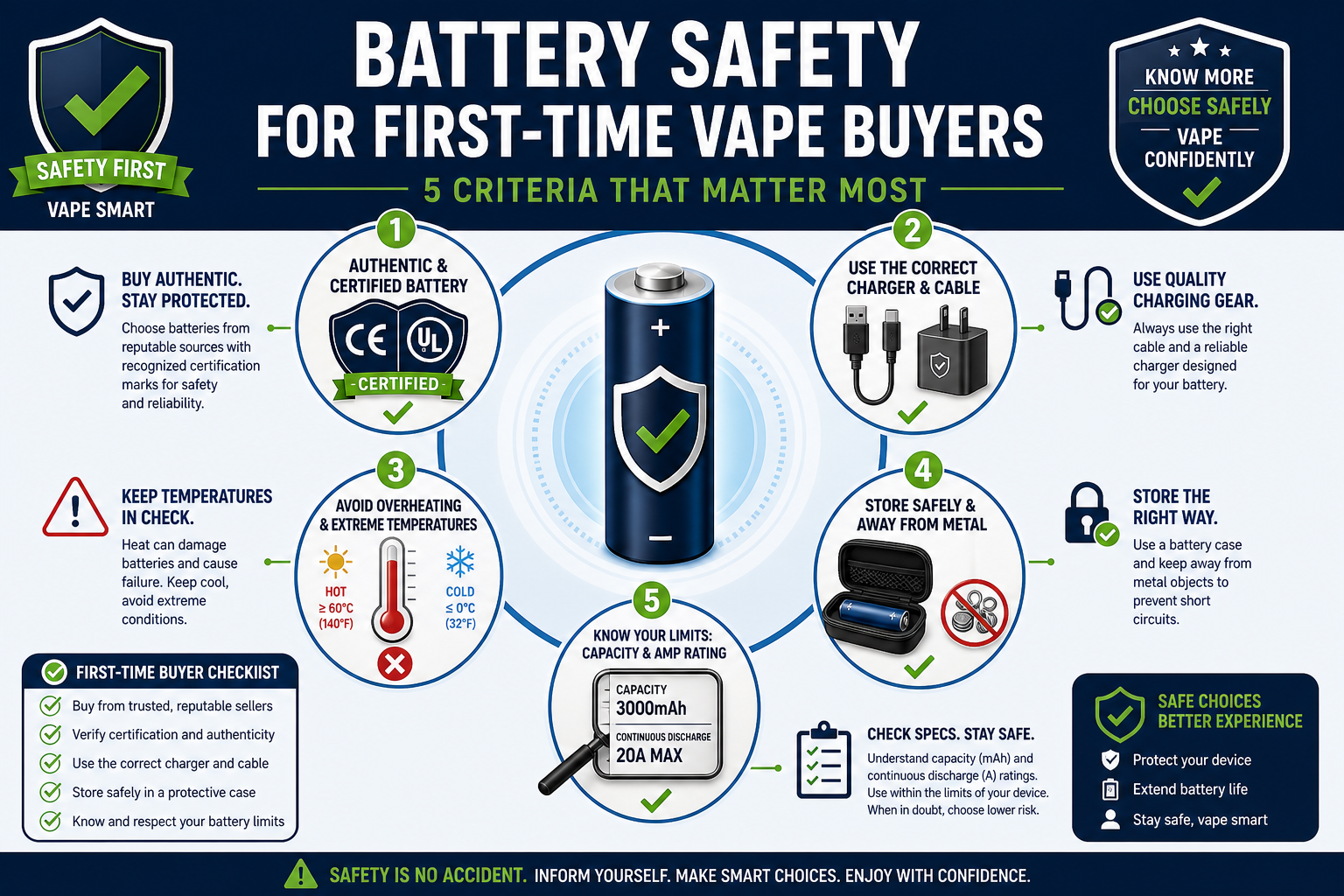
Every brand owner I've worked with starts with the same question: "Is this battery safe?" The honest answer is that you can't tell by looking at it. The safest approach is to make verification part of your buying ritual—a short checklist you run before you commit to a purchase.
Start with the basics: what kind of battery is it? Most vape devices use lithium-ion cells, either removable 18650s or hard-wired internal packs. The safety considerations are similar, but the verification steps differ slightly. For removable cells, you have more control—you can choose the cell and even test it yourself. For internal batteries, you're relying on the device manufacturer's claims, so you need to ask for documentation.
Here's the ritual: ask the supplier for the battery's datasheet, check the CDR, verify protection circuits, and look for certification marks. Do this every time, even if you've bought from them before. Battery specs can change without notice, and a "same" product might have a different cell inside.
Core loop
The core loop of battery safety verification is a cycle of check, test, and document. You repeat it for every new product batch.
Check the CDR. The continuous discharge rating is the maximum current the battery can safely deliver without overheating. For vape devices, you need to know the device's maximum power draw. Use the Coil Resistance Calculator to figure out the current draw from your wattage and coil resistance. If the current draw exceeds the CDR, you're asking for trouble—the battery will heat up, and in extreme cases, it can go into thermal runaway.
Verify protection circuits. Most internal batteries have a protection circuit board (PCB) that prevents overcharge, overdischarge, and short circuits. For removable cells, some have built-in protection, but many don't—you have to rely on the device's circuitry. Ask the manufacturer what protections are built in. If they can't tell you, that's a red flag.
Look for certifications. UL, CE, and other marks indicate the battery has passed safety testing. But don't just take the mark at face value—ask for the test report. A legitimate manufacturer will have it on hand. If they can't provide one, consider that a warning sign.
Document everything. Keep a file with datasheets, test reports, and correspondence about battery specs. This is your evidence if something goes wrong, and it helps you compare suppliers.
Optional flourish
Now that you've verified the basics, you can go a step further and test a sample batch yourself. You don't need a lab—just a multimeter and a charger. Check the battery's initial voltage, run a few charge/discharge cycles, and see if it holds a charge. This won't tell you everything, but it catches obvious duds.
Another flourish: use a battery analyzer to check the actual capacity and internal resistance. These devices are affordable and give you a better picture of the cell's health. If you're buying in large quantities, this is worth the investment.
And if you're really serious, send a sample to an independent testing lab for a full safety evaluation. It's not cheap, but for high-volume orders, it's a worthwhile insurance policy.
Closing reset
Battery safety isn't a one-time check. It's a mindset that you reset with every new product, every new batch, and every new supplier. After you've verified a batch, don't forget the basics of handling:
- Store batteries in a cool, dry place, away from direct sunlight and flammable materials.
- Use proper storage containers—ideally fireproof bags or metal cases for loose cells.
- Ship batteries as hazardous materials (Class 9), with proper packaging and labeling.
- Train your staff on safe handling and emergency procedures.
Remember, the moment you receive the batteries, you're responsible for them. A battery that's safe in the factory can become dangerous if mishandled in transit or storage.
Kill switches if it gets complicated
Sometimes you find a battery that looks perfect on paper but fails your checks. Or you discover that the supplier's test report is fake. That's when you need to pull the kill switch—stop the order, and don't proceed until you've resolved the issue.
Here are the red flags that should make you hit the brakes:
- The supplier can't provide a datasheet or test report.
- The CDR doesn't match the device's power requirements.
- The battery has no visible protection circuit, and the device doesn't have one either.
- The price is suspiciously low—cheap batteries often cut corners on safety.
- The certification mark looks off, or you can't verify it with the issuing body.
If any of these come up, it's better to walk away than to risk a safety incident. There are plenty of reputable suppliers out there, and your reputation is worth more than a good deal.
For more in-depth guidance, check out our Vape Battery Safety Guide that covers discharge rates, Ohm's law, and thermal runaway. And if you're new to battery safety, our first-time buyer criteria will help you build a solid checklist. If you need to calculate current draws on the fly, use our Coil Resistance Calculator.
Stay safe, and happy vaping.