
Why battery safety matters more than you think
Vapes run on lithium-ion batteries. They're powerful, compact, and generally safe when treated right. But they also have a flip side: if a cell is damaged, overcharged, or shorted, it can overheat and, in rare cases, catch fire. That's why every device you pick should have layers of protection—not just a good coil.
Most first-time buyers worry about flavor or nicotine strength, but battery safety is the one thing you shouldn't compromise on. You might not notice a safe battery when it works, but you'll definitely notice when it fails.
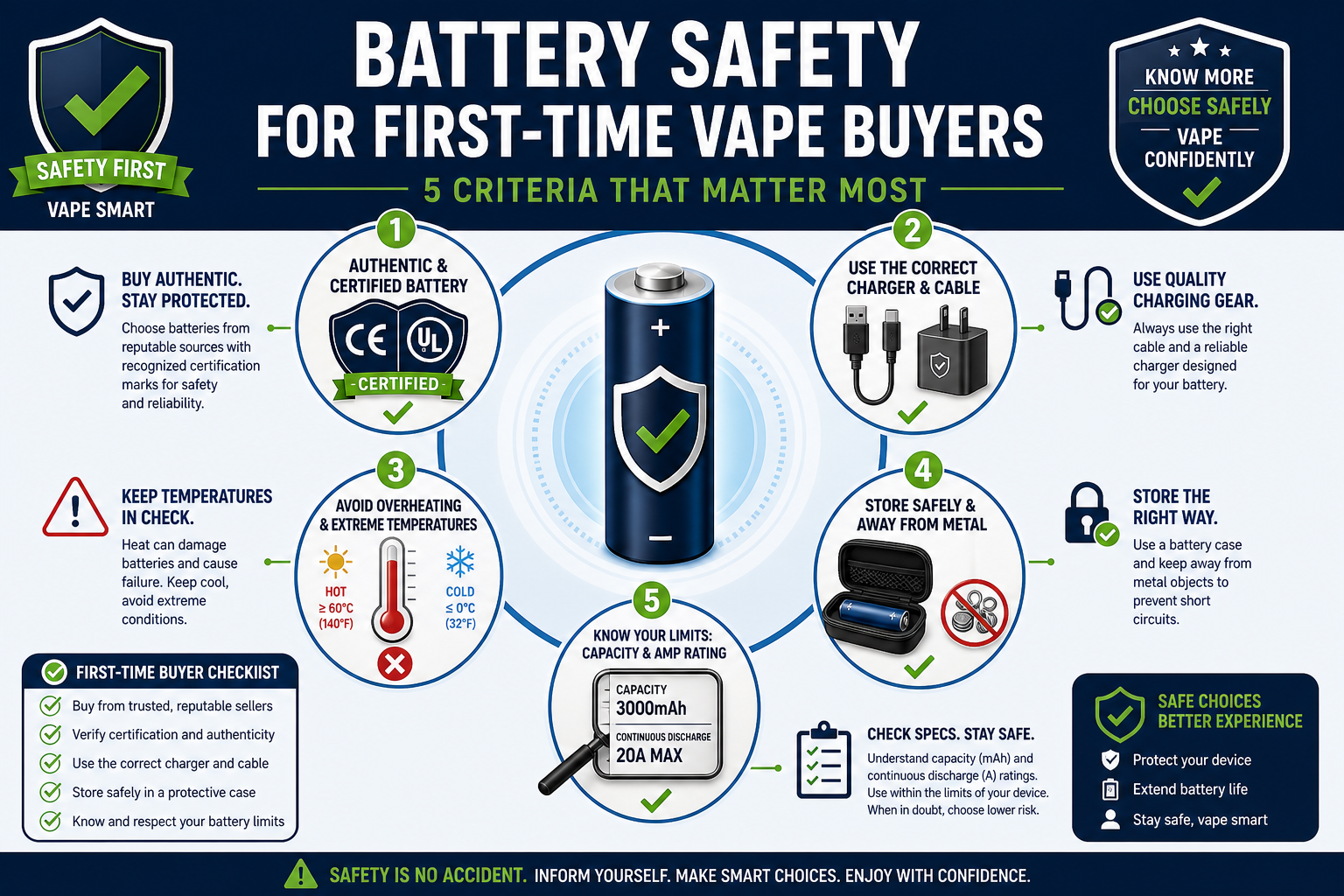
Criterion 1: Built-in protections (the non-negotiables)
Before anything else, check if the device has these four protections:
- Overcharge protection: Stops charging once the battery is full.
- Over-discharge protection: Prevents the battery from draining below a safe voltage.
- Short-circuit protection: Cuts power if something touches the wrong terminals.
- Overheat protection: Shuts down if the device gets too hot.
Many devices in the WINDBAR lineup, like the VERTEX-VISTA or LINQ-PRO, include these as standard. But don't assume—read the specs. If a product page doesn't list protections, ask the seller or choose another model.
If you're looking at disposable vapes, protections are harder to verify because you can't inspect the battery. But you can still check the label for safety marks and capacity.
Criterion 2: Battery brand and capacity you can trust
You don't need a PhD in lithium chemistry, but you should recognize the battery brand. Big names like Samsung, LG, Sony, and Panasonic make reliable cells. If a device uses a no-name cell, be cautious.
Capacity matters too, but not in the way you think. A higher mAh rating means more puffs, but it also means the battery is larger and may take longer to charge. For a first device, look for something in the range of 350–800 mAh—enough for a day of moderate use without being a brick.
And here's a tip: ignore the puff count on disposables. It's often marketing. The real tell is the battery capacity and whether the device has a charge port. A disposable with a micro-USB port is a plus because you can top it up instead of tossing it early.
Criterion 3: Clear battery indicator
You'd be surprised how many vapes have a tiny LED that blinks red when it's dying, but no way to tell how much charge is left. That's frustrating and unsafe—you might drain the battery completely, which stresses the cell.
Look for a device with at least a three-stage indicator (green, yellow, red). Some, like the VERTEX-25K, have a small percentage display. If you're always at 1% without warning, that's a bad sign.
A good indicator helps you charge at 20–30% rather than 0%, which extends battery life and reduces the risk of over-discharge.
Criterion 4: Charging habits that keep you safe
Even the best battery can fail if you charge it wrong. Here's what to do:
- Use the included cable and adapter. Third-party chargers can push too much current.
- Don't charge overnight while you sleep. Set a timer or charge during the day.
- Keep the device away from flammable surfaces while charging.
- If the device gets hot while charging, unplug it immediately.
Most modern vapes have overcharge protection, but that doesn't mean you should leave them plugged in for hours. Heat is the enemy of lithium batteries.
Criterion 5: Removable vs. sealed batteries—know the trade-off
Some devices, like the LINQ-SLIM, have a removable battery. That's great if you want to swap batteries on the go, but it also means you need to handle cells correctly. If you drop a battery, dent it, or put it in your pocket with keys, you're asking for trouble.
For a first-time buyer, a sealed internal battery is usually simpler and safer. You don't have to worry about damaged wraps or reverse polarity. If you do go removable, read our Vape Battery Safety Guide before you buy.
Also, if you're considering a device that requires you to build coils and use an external charger, that's a bigger commitment. Start with a pod system or a disposable that does the thinking for you.
How to weight these criteria
Here's a practical way to think about it: protections are 40% of the decision, battery brand/capacity 25%, indicator 15%, charging habits 10%, and removable vs. sealed 10%. That's not a scientific formula, but it reflects real risk.
You can trade off capacity for a better brand—a 500 mAh Samsung cell is safer than a 1000 mAh no-name. And don't skip protections for a sleeker design. A device that's pretty but has no overcharge protection is a ticking clock.
For most first-timers, a sealed device from a known brand with listed protections and a clear indicator is the sweet spot. If you're unsure, check the product page or ask in the community.
Wrapping it up
Battery safety isn't scary—it's just a checklist. Look for protections, trust the brand, watch the indicator, charge smart, and decide if you want to deal with removable cells. That's it.
If you're still lost, browse the Windbar Community to see what others with similar experience levels chose. And remember: a device that keeps you safe is the one you'll actually enjoy using.
This guide is for adults 21+ and is for educational purposes only. Always follow the manufacturer's instructions.
Criteria FAQs
Q: What battery protections should a beginner's vape have?
Look for at least overcharge, over-discharge, short-circuit, and overheat protection. Many devices also include reverse polarity protection if they have removable batteries. These are your safety net against common mistakes.
Q: How can I tell if a vape battery is safe?
Check that the battery has a clear brand and capacity rating (e.g., mAh). Avoid no-name cells. Also, look for safety certifications like CE, RoHS, or UL—these indicate the product was tested to some standard.
Q: Is it safe to charge a vape overnight?
It's not recommended. Even with overcharge protection, charging overnight increases the risk of overheating and battery stress. Charge when you're awake and unplug once full.
Q: Should beginners use devices with removable batteries?
Only if you're willing to learn basic battery safety, like proper storage, handling, and Ohm's law. For most beginners, a sealed device with internal batteries is simpler and safer.
Q: What does the battery indicator on a vape actually tell me?
It shows remaining charge, so you know when to charge. Some devices use a percentage, others a color light. It helps you avoid draining the battery completely, which is bad for battery health.
In this topic cluster
- Battery Safety articles
- Vape Battery Safety Guide: Discharge Rates, Ohm's Law & Thermal Runaway Explained
- WINDBAR ohm's law calculator: volts, ohms, watts, and the 4.4 V × 1 Ω hook
- WINDBAR wattage calculator: coil ohms, inhale style, and D91 4.4 V