

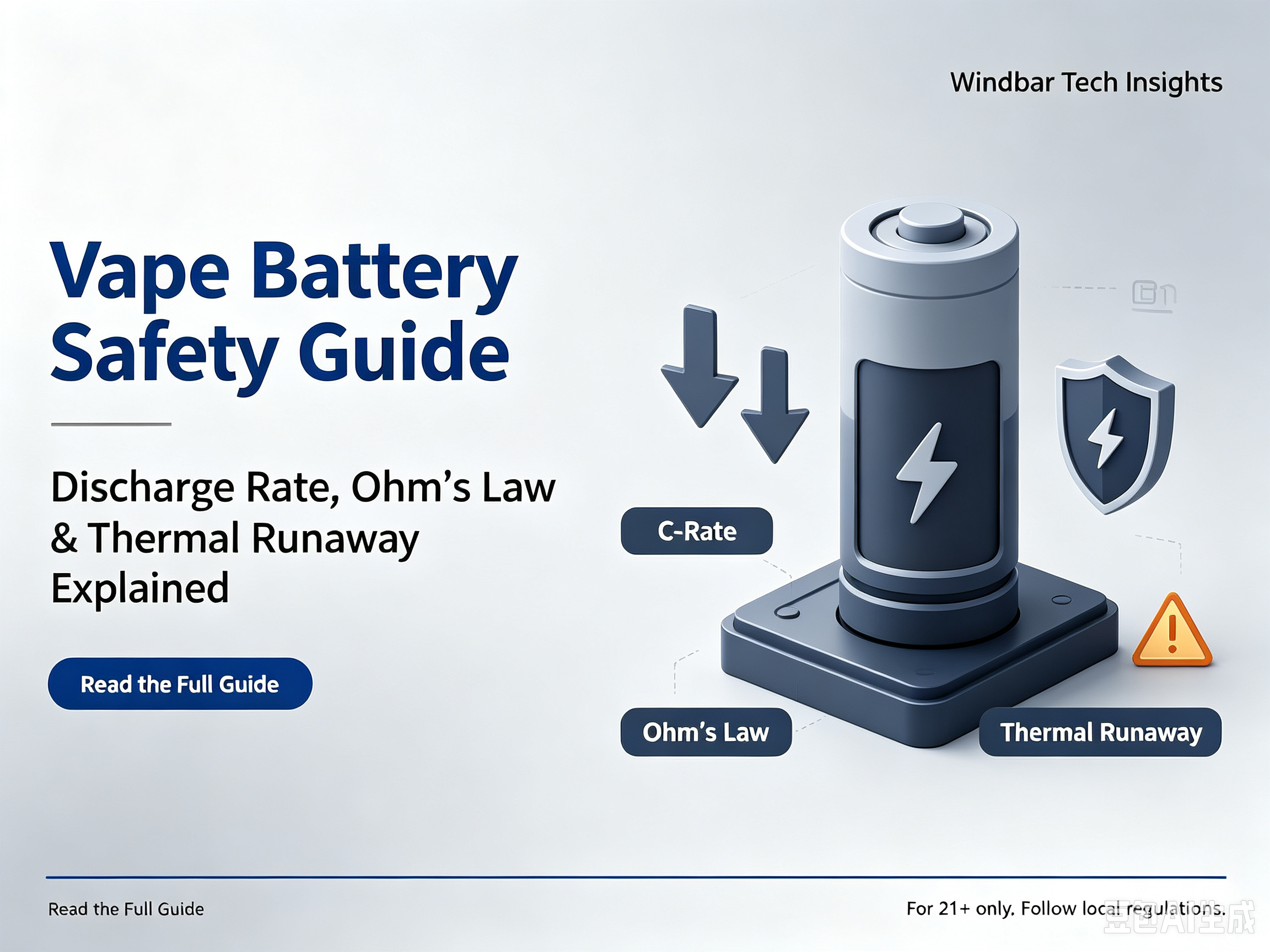
If you've ever picked up a vape device and wondered why battery specs matter beyond just "how long it lasts," you're not alone. Vape battery safety is one of the most misunderstood topics in the industry — and for good reason. Misunderstanding discharge rates, ignoring Ohm's Law, or using a damaged cell can lead to short circuits, over-discharge, or even thermal runaway.
Understanding how vape batteries deliver power — including discharge rates, voltage sag, and the relationship between resistance and current — is the single most important factor in preventing dangerous malfunctions.
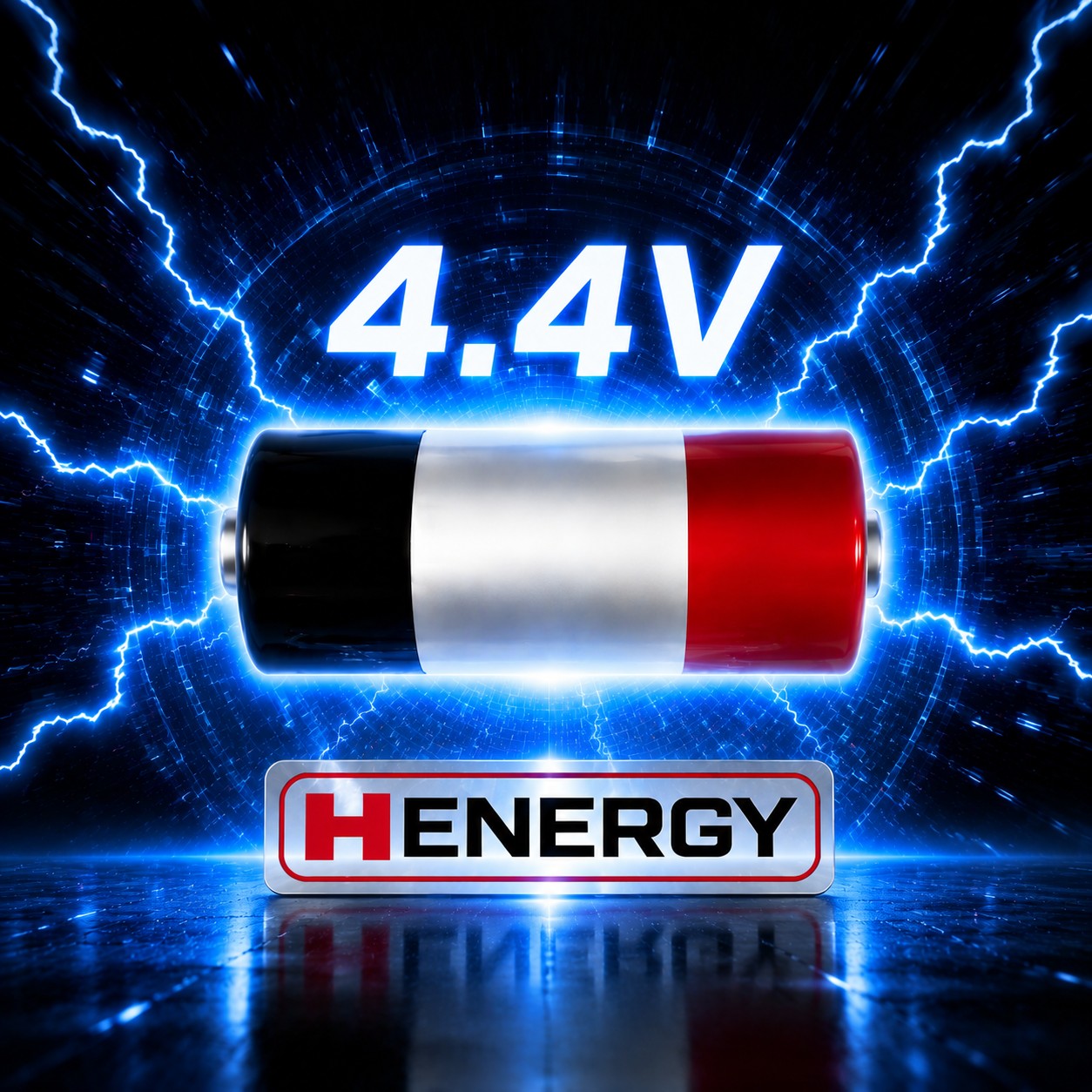
In this guide, we'll break down the science behind battery discharge rates, show you how Ohm's Law applies to your vaping setup, explain exactly why short circuits and thermal runaway happen, and give you a practical safety checklist and buying guide. We'll also look at why Windbar's 4.4V battery platform represents a meaningful advancement in vape battery engineering.
Understanding Battery Discharge Rates in Vaping
What Is a Discharge Rate?
A battery's discharge rate — often expressed as a "C-rating" — tells you how quickly a cell can safely release its stored energy. A 1C rating means the battery can deliver its full capacity in one hour. A 2C rating means it can deliver twice that current, emptying in 30 minutes.
For vaping, discharge rates matter because coil resistance determines how much current the battery must supply. A sub-ohm coil (below 1.0Ω) draws significantly more current than a higher-resistance coil, demanding a battery with a higher continuous discharge rating.
Most 18650 cells used in vaping have continuous discharge ratings between 15A and 30A. Using a battery with a discharge rating below your coil's current demand is one of the most common causes of battery failure in vaping.
Continuous vs. Pulse Discharge
Manufacturers often list two discharge specifications: continuous and pulse. The continuous rating is the maximum current the cell can sustain indefinitely without exceeding safe temperature limits. The pulse rating is a short-duration peak (usually 2-5 seconds) that the cell can handle during brief high-drain moments.
For regulated devices, the chipset manages power delivery and typically keeps current draw within safe limits. For mechanical mods — which have no chipset — the battery directly powers the coil, making the continuous discharge rating absolutely critical.
| Battery Type | Typical Capacity | Continuous Discharge | Best Suited For |
| High-drain 18650 | 2000-2500mAh | 25-30A | Sub-ohm, mechanical mods |
| Mid-drain 18650 | 2500-3000mAh | 15-25A | Regulated mods, mid-wattage |
| High-capacity 21700 | 4000-5000mAh | 15-30A | Extended use, higher wattage |
| Integrated Li-ion (disposable) | 400-650mAh | 1-3A | Low-wattage pod systems |
Why Voltage Matters: The 3.7V to 4.2V Window
Standard lithium-ion cells operate between 3.0V (minimum safe discharge voltage) and 4.2V (full charge). As the battery discharges, voltage gradually drops — a phenomenon called "voltage sag." Under heavy load, voltage sag becomes more pronounced, which directly affects vapor production and flavor consistency.
This is where voltage platform design becomes a critical differentiator. Most disposable and pod systems use standard 3.7V nominal cells, meaning output power declines steadily throughout the battery's life. Windbar's 4.4V battery platform operates at a higher voltage ceiling, delivering more consistent power output across the full discharge cycle — which means more stable vapor production and flavor from first puff to last.
Ohm's Law in Vaping: The Math That Keeps You Safe
The Core Formula
Ohm's Law defines the relationship between voltage (V), current (I), and resistance (R):
V = I × R
This can be rearranged to solve for any variable:
• Current: I = V / R
• Resistance: R = V / I
In vaping, a fully charged 4.2V cell paired with a 0.5Ω coil draws: I = 4.2 / 0.5 = 8.4 amps.
That same coil on a fresh 4.2V cell is well within most batteries' safe limits. But consider what happens with a 0.2Ω coil: I = 4.2 / 0.2 = 21 amps. Suddenly, you need a high-drain cell rated for at least 21A continuous.
Power Calculation: Watt's Law
Power (P) in watts is calculated as: P = V² / R
Using the same examples:
• 4.2V on a 0.5Ω coil = 4.2² / 0.5 = 35.3 watts
• 4.2V on a 0.2Ω coil = 4.2² / 0.2 = 88.2 watts
This is why lower resistance generates dramatically more heat — and why battery demand increases exponentially as coil resistance drops. Understanding this relationship helps you choose the right battery for your setup and avoid pushing cells beyond their limits.
How the 4.4V Platform Changes the Equation
With Windbar's 4.4V platform, the higher operating voltage means the device can achieve target wattage at lower current draw. Since P = V × I, a higher voltage allows the same power output with less current — reducing stress on the battery cell.
For example, delivering 10W at 4.4V requires only 2.27A of current, compared to 2.70A at 3.7V. That 16% reduction in current draw translates directly into less heat generation, longer battery life, and a wider safety margin against over-discharge.
What Causes Short Circuits, Over-Discharge & Thermal Runaway
Short Circuits: When Resistance Drops to Near Zero
A short circuit occurs when the positive and negative terminals of a battery connect with minimal resistance between them. In vaping, this typically happens due to:
• Damaged battery wrap (the plastic sleeve insulating the cell)
• Coil builds with stray wire strands touching the deck
• Condensation or e-liquid leaking into the battery compartment
• Mechanical mod firing with an improperly installed coil
In a short circuit scenario, current spikes to extremely high levels — potentially 50A or more on a direct short. A high-quality 30A-rated cell with built-in protection can handle brief short-circuit events; a damaged or counterfeit cell cannot, and may vent or rupture within seconds.
Over-Discharge: The Silent Battery Killer
Lithium-ion cells should never be discharged below their minimum safe voltage — typically 2.5V to 3.0V, depending on the cell chemistry. Over-discharge causes copper dendrites to form inside the cell, which can pierce the separator and create internal short circuits.
An over-discharged cell may appear functional after recharging, but the internal damage is permanent. These cells become unreliable and significantly more prone to thermal events.
Signs of over-discharge include:
• Device shutting off at higher percentages than expected
• Noticeable decrease in vapor production before the battery indicator shows empty
• Battery feeling warm during normal use
• Inconsistent power delivery or flickering output
Thermal Runaway: The Chain Reaction
Thermal runaway is the most severe battery failure mode. It occurs when heat generated inside the cell exceeds the cell's ability to dissipate it, triggering a self-sustaining chain reaction:
1. Heat buildup from excessive current draw, external heat, or internal short
2. Separator breakdown at approximately 130°C (266°F), causing internal short circuits
3. Electrolyte decomposition releasing flammable gases
4. Cathode material breakdown at approximately 200°C (392°F), releasing oxygen
5. Thermal event — venting, fire, or explosion
The key takeaway: thermal runaway is almost always preventable through proper battery selection, regular inspection, and respecting the electrical limits of your setup.
Vape Battery Safety Checklist
Use this checklist before every build and every battery swap:
Battery Inspection
• ☐ Battery wrap is intact — no tears, scratches, or peeling
• ☐ No visible dents, bulges, or corrosion on terminals
• ☐ Battery age is under 1 year (or 300 charge cycles)
• ☐ Cells are purchased from authorized dealers (avoid counterfeits)
Build Verification
• ☐ Coil resistance measured with a reliable ohmmeter before firing
• ☐ Current draw calculated using Ohm's Law and within battery's CDR
• ☐ No stray wire strands that could contact the deck or positive pin
• ☐ Attomizer is clean and dry — no e-liquid in the battery compartment
Device Safety
• ☐ Using a regulated device with proper safety protections (short circuit, over-discharge, over-current)
• ☐ Firmware is up to date
• ☐ Battery ventilation ports are not blocked
• ☐ Carrying spare batteries in a protective case (not loose in a pocket)
Charging Safety
• ☐ Use a dedicated external charger — not the device's USB port for prolonged charging
• ☐ Never leave charging batteries unattended
• ☐ Charge on a non-flammable surface
• ☐ Remove batteries from charger when fully charged (do not trickle charge)
Vape Battery Buying Guide: What to Look For
Match the Battery to Your Device Type
For disposable and pod systems, integrated lithium-ion cells with lower discharge ratings are standard. Focus on overall build quality and brand reputation rather than raw specs.
For refillable pod systems and starter kits, look for cells rated at 15A-20A continuous discharge with capacities around 2500-3000mAh. These balance runtime with safe current delivery.
For sub-ohm tanks and mechanical mods, high-drain cells rated 25A-30A are essential. Capacity will be lower (2000-2500mAh), but the discharge headroom protects against dangerous current spikes.
Red Flags When Buying Batteries
• Prices significantly below market average (counterfeit indicator)
• Batteries with unrealistic capacity claims (e.g., "3500mAh 18650" — physics limits actual capacity)
• Missing or damaged battery wraps
• Purchased from non-specialized retailers (gas stations, auction sites)
• No manufacturing date or batch number
Trusted Sources
Purchase batteries only from authorized vape retailers or directly from known cell manufacturers' distributors. Reputable brands include Samsung, Sony/Murata, LG, and Molicel. Always verify the batch number against the manufacturer's database when possible.
Why Windbar's 4.4V Battery Platform Matters
Most vape devices on the market — from disposables to pod systems — use standard 3.7V nominal lithium-ion cells. Windbar's 4.4V battery platform takes a fundamentally different approach to power delivery, and the engineering advantages extend well beyond a simple voltage bump.
Consistent Performance From First Puff to Last
With a standard 3.7V cell, power output declines steadily as voltage drops during discharge. A device that delivers 8W when fully charged may output only 5-6W by the time the battery reaches 3.3V. This voltage decline affects vapor production, flavor intensity, and overall user experience.
Windbar's 4.4V platform starts at a higher voltage and maintains output closer to the target wattage for a longer portion of the discharge cycle. The result is a noticeably more consistent vaping experience throughout the battery's life — not just in the first few hours after charging.
Extended Battery Life and Fewer Charge Cycles
The higher voltage platform means less current is needed to achieve the same power output. Since battery wear is directly related to current draw and thermal stress, operating at lower current extends both the per-charge runtime and the overall cycle life of the cell.
For B2B buyers and retailers, this translates into fewer warranty claims, higher customer satisfaction, and a stronger brand reputation for reliability.
Enhanced Safety Margin
By operating at lower current for equivalent wattage, the 4.4V platform generates less internal heat within the battery cell. Reduced heat means:
• Lower risk of thermal stress on internal components
• Less voltage sag under load
• Wider margin between operating conditions and the cell's thermal limits
• More stable performance in high-temperature environments
What This Means for Your Business
For retailers and distributors evaluating vape hardware suppliers, the battery platform is a specification that directly impacts end-user satisfaction and product return rates. Windbar's 4.4V platform addresses one of the most common user complaints — inconsistent performance as the battery depletes — at the engineering level, not through software compensation.
Explore Windbar's product directory to compare battery specifications across verified brands and find hardware that matches your market's requirements.
Frequently Asked Questions
How do I calculate the safe discharge rate for my vape coil?
Use Ohm's Law: divide the battery's fully charged voltage (4.2V) by your coil's measured resistance. For example, a 0.5Ω coil draws 8.4A (4.2 ÷ 0.5). Ensure your battery's continuous discharge rating (CDR) exceeds this value by at least 20% for a safe margin.
How often should I replace my vape battery?
For removable 18650 and 21700 cells, replace after 300 charge cycles or 12 months of regular use — whichever comes first. If you notice increased heat during use, faster-than-expected drain, or any damage to the battery wrap, replace the cell immediately.
Can I use any 18650 battery in my vape mod?
No. Not all 18650 cells are rated for high-discharge applications. Camera flashlight batteries optimized for capacity often have low CDR ratings (5-10A) and can be dangerous in vaping devices. Always use cells from reputable brands rated for at least 15A continuous discharge for regulated mods, and 25A+ for mechanical mods.
What is thermal runaway and how do I prevent it?
Thermal runaway is a self-sustaining chain reaction where internal cell heat triggers separator failure, electrolyte decomposition, and potentially fire. Prevention includes: never using damaged batteries, always using batteries within their rated discharge limits, avoiding extreme temperatures, and using regulated devices with built-in safety protections.
Why does my vape produce less vapor as the battery drains?
This is caused by voltage sag — as the battery's state of charge decreases, its output voltage drops, resulting in lower power delivery to the coil. Some platforms address this through voltage regulation or higher-voltage cell designs. Windbar's 4.4V platform, for instance, reduces voltage sag impact by starting at a higher voltage ceiling, maintaining more consistent output throughout discharge.