
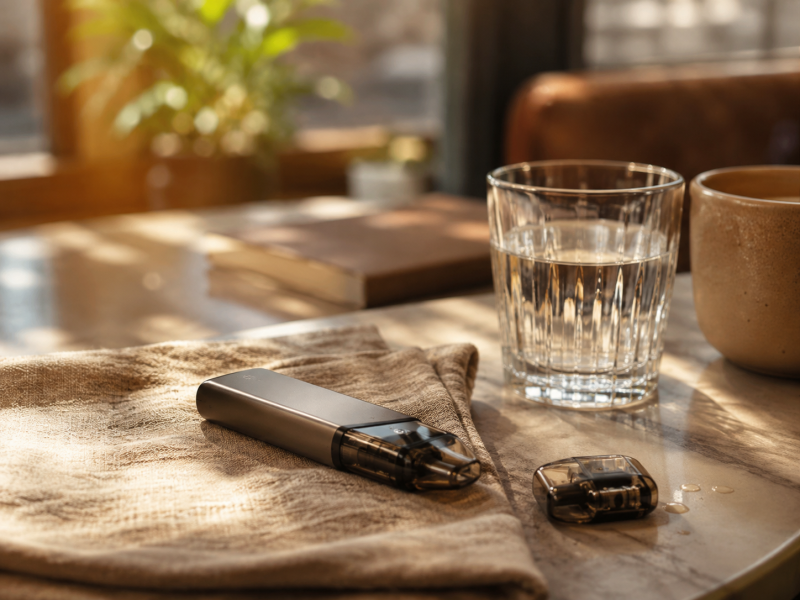
Mistake cluster
If you're chasing a leak, you've probably already tried the usual: wipe it, turn it, maybe even guilt-tripped the pod. But most home leaks trace back to three everyday mistakes that look unrelated until you see them side by side.
Mistake one: filling to the brim. You're in a hurry, you top it off like a gas tank, and then it weeps from the airflow hole. Overfilling leaves no room for air, and the juice has nowhere to go but out.
Mistake two: leaving it in a hot car or on a sunny windowsill. Pressure builds inside the sealed pod as the liquid warms. When you pick it up, it's already weeping. This one feels like a mystery because the pod was fine an hour ago.
Mistake three: using a pod past its prime. Seals get stiff, the rubber lip loses its grip, and eventually the pod seeps even when it's half full. You think the whole device is broken, but it's just a tired pod.
Three different symptoms, one shared root cause. Let's get to it.
Shared root cause
The common thread is pressure imbalance. In a sealed pod, liquid sits in a chamber with a tiny air inlet. When that chamber gets overfilled, heated, or the seal loses its ability to hold a stable vacuum, the pressure equalizes by pushing liquid out the path of least resistance—usually the coil and airflow hole.
Think of it like a straw with your finger over the top. If the seal is perfect and the temperature is steady, the liquid stays. Crack the seal or change the temperature, and the column drops. Same physics, smaller scale.
That's why the fix isn't about buying a new device or switching coils more often. It's about controlling the pressure inside the pod on purpose.
One fix pattern
The pattern is fill — rest — check. It takes thirty seconds and costs nothing.
Step 1: Fill with a gap. Stop about a millimeter below the fill line. If there's no line, leave a visible air pocket at the top. This gives the liquid room to expand when it warms.
Step 2: Rest before vaping. After filling, set the pod upright for 2–3 minutes. This lets the coil fully saturate and lets any trapped air bubble out. Vaping right after a fill is like shaking a soda can—you're asking for a mess.
Step 3: Check the seals. Every few days, give the pod a quick once-over. Look at the rubber gasket around the mouthpiece and the base. If it looks cracked, stiff, or just… flatter than it used to, replace the pod. Don't wait for a leak to remind you.
That's the whole pattern. It fixes most leaks because it addresses the pressure imbalance at every point where it forms.
How to verify the fix stuck
Give it a day. After you've done the fill-rest-check routine, keep the pod upright and at room temperature. If it doesn't leak within 24 hours, you're good.
Want a faster check? Fill a pod, rest it, then hold it upside down over a tissue for ten seconds. If it's dry, the seal is holding. If it weeps, you've got a worn seal or a crack.
One more thing: keep the device upright when you're not using it. Lying it on its side in a bag is a recipe for a slow drip that you'll only notice when your pocket feels damp.
Edge cases the pattern misses
The fill-rest-check routine covers most leaks, but not all. Here's when it won't save you.
Cracked pod or tank. If you see a visible crack, no routine will help. Replace the pod—don't try to patch it. Glue and tape break down in e-liquid and you'll end up vaping something you shouldn't.
Leaking from the bottom, not the airflow. That points to a worn base seal or a damaged coil. Try a fresh coil first; if it still leaks, the pod is done.
Leaks that happen even when you never overfill and always rest. Some devices just have a bad batch of pods. If you've gone through two pods with the same leak pattern, consider a different pod brand or a different device altogether. Not every kit is built the same.
And if you're using a WINDBAR device like the VERTEX-VISTA or LINQ-SLIM, the same logic applies—check the pod, not the battery.
When to retire the device
If you've replaced the pod, checked the seals, and it still leaks, it's not worth fighting. A leaking device wastes juice, ruins pockets, and can make the battery area damp, which is a safety risk. When in doubt, retire the device and recycle it properly.
Leaks are annoying, but they're usually a sign of a small habit, not a broken machine. A minute of routine keeps your kit dry and your day mess-free.
This content is for adults 21+ and is not intended to diagnose or treat any condition. Always follow the manufacturer's instructions for your specific device.
Sources & Further Reading
- FDA – Tips for Vaping Products — Official guidance on handling and storing vaping products safely.
One pattern
- Most home pod kit leaks aren't a hardware failure—they're a routine slip-up: overfilling the pod, letting pressure build in the tank, or using a pod past its seal life. The single fix that covers all three is a consistent 'fill—rest—check' routine. Do that, and you'll cut most leaks without buying anything.
- Overfilling is the #1 leak trigger—leave a small air gap in the pod.
- Pressure swings from temperature changes can push juice out—store your kit upright and at room temp.
- Check the pod's seals and replace it when they look worn—not when it stops working.