


Running a vape shop in 2026 is not like running any other retail business. Every layer of your operation — taking a card payment, checking an ID, shipping a package, paying a tax — sits inside a web of state and federal rules that generic retail software was never built to handle. A generic stack quietly gets merchants fined, frozen, or shut down. A dedicated stack is what keeps you open.
This guide is the map. It walks through why vape shops need specialized tools, the six categories that make up a complete stack, concrete recommended setups for single stores, chains, and online-only businesses, a monthly cost calculator you can use to budget, and a printable compliance checklist you can hand to your team today. Every tool category covered here gets its own deep-dive article — links at the end of this guide.
TL;DR — the 60-second version Six layers: POS & inventory, high-risk payment processing, age verification, ecommerce platform, compliance & tax software, shipping & logistics. Why dedicated: mainstream processors (Stripe, PayPal, Square) prohibit vape; age-restriction and PACT Act reporting are mandatory, not optional. Budget: a complete single-store stack runs roughly $330–480/month plus ~1.0–2.0% of card volume in processing fees. Online-only is cheaper on software but heavier on compliance. Non-negotiables: high-risk payment processor, age verification at every sale, PACT Act registration and reporting for anything you ship.
1. Why Vape Shops Need a Dedicated Tech Stack
Here is the uncomfortable truth most new vape store owners learn the hard way: the software that runs a clothing boutique, a coffee shop, or a general ecommerce store will not run a vape shop — at least not for long. Three structural differences separate vape retail from normal retail, and each one demands dedicated tooling.
1.1 Vape is a "high-risk" payment category
Card networks and acquiring banks classify vape merchants under high-risk categories (MCC 5993 — tobacco/vape retailers). High-risk means higher average chargeback ratios, stricter underwriting, and a higher chance of regulatory liability landing on the processor. Mainstream providers simply refuse this business class:
- Stripe, PayPal, and Square all prohibit tobacco/vape sales in their acceptable-use policies. They will terminate accounts and hold funds when they detect vape transactions — sometimes after months of processing.
- Specialized "high-risk" processors (reviewed in depth in our payment processor guide) underwrite vape merchants, offer rolling reserves, and understand FDA/PACT exposure. They cost more — typically 0.3–1.5% over interchange plus a monthly gateway fee — but they don't freeze you.
If your POS or ecommerce platform can only plug into mainstream gateways, you haven't actually solved payments. You've just postponed the freeze.
1.2 Every sale is age-restricted
Federal law (and the PACT Act) requires age verification of 21+ for all tobacco and vaping products — at the point of sale in-store, at checkout online, and again at the door on delivery. A generic POS doesn't scan IDs, a generic checkout doesn't run a database age check, and a generic shipper doesn't verify who signs the package. Each gap is a separate fine waiting to happen, and state enforcement ranges from $500 to $10,000+ per violation, with license revocation as the ceiling.
1.3 Compliance is a recurring workflow, not an event
Beyond the sale itself, vape businesses owe ongoing regulatory obligations:
- FDA: retailer registration, selling only products with marketing authorization or a pending/effective PMTA, record-keeping.
- PACT Act: registering with ATF before shipping, verifying age at delivery, collecting state excise taxes, and filing recurring sales reports to each destination state.
- State-level: licenses, excise taxes on top of sales tax (some states tax per-milliliter or per-nicotine-milligram), flavor bans, and online-sale bans.
Doing all of this in spreadsheets works until the first audit. Dedicated compliance software turns it into automated reporting with audit trails — more on that in our compliance stack guide.
The "just use Shopify" trap Shopify is excellent — until you try to take a payment. Shopify Payments explicitly prohibits vape, so you'll need a third-party high-risk gateway anyway, plus an age-gate app for checkout, plus PACT Act reporting setup, plus a compliant shipping method. By the time you assemble all that, you've built a vape-specific stack on top of Shopify without any of the guardrails. It can work; it is never "just Shopify."
2. The 6 Tool Categories at a Glance
A complete vape shop tech stack covers six categories. Every store needs most of them; the combination depends on whether you sell in-store, online, or both. Here is the overview, with links to each category's dedicated deep-dive:
| # | Category | What it does for a vape shop | Typical cost |
|---|---|---|---|
| 1 | POS & Inventory | Ring sales, scan IDs at checkout, track age-restricted inventory, manage reordering. Multi-store sync for chains. | $69–299/mo |
| 2 | High-Risk Payments | Underwrite vape merchants, accept cards online and in-store, manage chargebacks and reserves. non-negotiable | interchange +0.3–1.5% + $10–30/mo |
| 3 | Age Verification | ID scan in-store; database/KYC checks at checkout; adult signature capture at delivery. | $30–150/mo |
| 4 | Ecommerce Platform | Your online storefront — product catalog, cart, checkout, age gate integration, PACT-compliant shipping setup. | $29–200/mo |
| 5 | Compliance & Tax Software | PACT Act reporting, excise/sales tax automation across states, deadline calendar, document retention. | $49–300/mo |
| 6 | Shipping & Logistics | PACT-compliant carriers (USPS is banned for vape), adult-signature at delivery, age-verified dropship/wholesale flows. | per-package + $0–100/mo |
2.1 Decision tree: which tools do you need?
Answer these questions in order, and the tree routes you to the right combination:
- Do you sell in a physical store? → If YES: you need a vape-capable POS with built-in ID scanning, plus a high-risk processor that can pair with that POS.
- Do you also sell online? → If yes: add an ecommerce platform, online age verification at checkout, and PACT-compliant shipping.
- Multiple locations? → Add multi-store inventory sync and consolidated reporting (chain-level compliance dashboard).
- Online-only? → Skip POS hardware; prioritize ecommerce + age verification + PACT shipping + tax automation. In-store only? → Skip ecommerce; prioritize POS + ID scanning + high-risk payments + state licensing.
Two decisions dominate everything else: where you sell (in-store / online / both) and how many locations you run. Everything downstream — which POS, which gateway, which compliance tool — follows from those two answers.
3. Recommended Stacks by Store Type
Rather than listing every tool on the market, here are three concrete, buildable stacks — one per store archetype. Each is a real-world configuration using tools we review in depth in the comparison articles linked at the end of this guide. Costs are list prices; add your payment-processing markup on top of card volume.
3.1 Stack A — Single Store (Brick & Mortar)
Best for: one location, foot traffic, local customer base.
| Layer | Recommended pick | Cost |
|---|---|---|
| POS & inventory | KORONA POS (vape-ready) or Lightspeed Retail | $79–119/mo |
| Payments | High-risk processor paired with your POS (e.g., WAAVE, PayKings, EMB) | ~1.0–1.8% total |
| Age verification | POS-integrated ID scanner (built into KORONA; third-party hardware for Lightspeed) | $0–30/mo |
| Ecommerce | Optional: simple storefront or skip until volume justifies it | $0–29/mo |
| Compliance | State sales-tax automation (Avalara or similar) if not bundled | $0–50/mo |
| Shipping | N/A for in-store; carrier account if you ship locally | — |
Estimated total: $95–230/month + processing fees (typically 1.0–1.8% of card volume)
3.2 Stack B — Multi-Location Chain
Best for: 2–20+ locations, central buying, uniform compliance.
| Layer | Recommended pick | Cost |
|---|---|---|
| POS & inventory | Lightspeed Retail (multi-store) or KORONA multi-location | $119–299/mo |
| Payments | Single high-risk processor with consolidated reporting across locations | ~1.0–1.8% total |
| Age verification | Chain-wide ID scan + centralized audit log | $30–60/mo |
| Ecommerce | Unified POS-ecommerce sync (one catalog, both channels) | $50–200/mo |
| Compliance | Chain-level PACT Act + multi-state tax automation; license renewals calendar | $100–300/mo |
| Shipping | PACT-compliant carrier contract + adult-signature workflow | per-package |
Estimated total: $300–860/month + processing fees · chains usually negotiate POS and processor pricing at volume
3.3 Stack C — Online-Only (Ecommerce)
Best for: no storefront, direct-to-consumer shipping. Highest compliance load per order.
| Layer | Recommended pick | Cost |
|---|---|---|
| Ecommerce platform | Shopify/WooCommerce + vape-capable setup, or a vape-native ecommerce platform | $29–99/mo |
| Payments | High-risk gateway (not Shopify Payments / Stripe) | ~1.2–2.0% total |
| Age verification | Checkout age check (BlueCheck, Veriff, Yoti, Token of Trust) + delivery ID | $50–150/mo |
| Compliance | PACT Act reporting + multi-state excise & sales tax automation | $100–250/mo |
| Shipping | PACT-compliant carrier (USPS banned) with adult signature at delivery | $8–20/package |
| POS | None (skip hardware) | — |
Estimated total: $180–500/month + processing fees + per-package shipping · online-only has the lowest software floor but the highest per-order compliance cost
Two rules that apply to every stack ① Payment processing must be high-risk capable — this is the single most common fatal mistake. ② Age verification is not a feature you can turn off to "save money"; it is the difference between a fine and a license revocation in most states.
4. Monthly Cost Calculator
Use the table below to estimate your stack. Pick one option per row (Low / Mid / Premium) and add them up. Processing fees are shown separately because they scale with volume.
| Line item | Low | Mid | Premium |
|---|---|---|---|
| POS & inventory | $0–69 | $79–119 | $119–299+ |
| High-risk payment gateway | $10–15 | $15–25 | $25–50 |
| Age verification | $0–30 | $30–80 | $80–150 |
| Ecommerce platform | $0–29 | $29–99 | $99–200 |
| Compliance & tax software | $0–49 | $49–150 | $150–300 |
| Shipping (per package) | $8–12 | $10–15 | $12–20 |
| Hardware (amortized) | $0 | $15–30 | $30–80 |
Formula: Monthly stack = (sum of your software line items) + (processing fees: 1.0–2.0% of average monthly card volume) + (per-package shipping × average monthly packages). Example 1 — single store: POS $79 + gateway $20 + age verify $15 + compliance $49 + hardware $20 = $183/month + 1.3% of $40,000 volume = $520 → $703/month all-in. Example 2 — online-only: ecommerce $49 + gateway $20 + age verify $80 + compliance $150 = $299/month + 1.5% of $30,000 = $450 + 400 packages × $12 = $4,800 → ~$5,549/month all-in. Shipping is your biggest line item; negotiate carrier volume pricing early.
5. Compliance Checklist (Printable)
This checklist mirrors what a compliance audit checks. Work through it with your team — tick items as you go, then print or save this page as PDF for your compliance binder.
Before you open
- ☐ Register with FDA as a tobacco retailer (required to sell any tobacco/vape product)
- ☐ Register with ATF under the PACT Act if you will ship any products
- ☐ Obtain state tobacco/vape retailer license for every state you operate or ship to
- ☐ Obtain local business and tobacco permits (city/county)
- ☐ Check your state's flavor-ban status — do not stock banned products
- ☐ Confirm every product you sell has FDA marketing authorization, a pending application, or grandfathered status — keep the list
Every sale
- ☐ Verify customer is 21+ before the transaction (ID scan in-store; age check at online checkout)
- ☐ No sales to anyone unable to produce valid ID — no exceptions
- ☐ For deliveries: verify age at the door and obtain adult signature (PACT Act requirement)
- ☐ Record retention: keep sale and age-verification logs per your state's retention window
Monthly / quarterly
- ☐ File PACT Act sales reports to destination states (frequency depends on volume thresholds)
- ☐ Remit state excise tax on vape products (per-mL or per-nicotine where applicable)
- ☐ File state sales tax returns
- ☐ Reconcile processor settlement reports against your POS reports
Yearly / when regulations change
- ☐ Review state law changes: tax rates, flavor bans, online-sale bans, shipping bans
- ☐ Re-verify PMTA status of every SKU you sell (enforcement actions change product availability)
- ☐ Renew licenses and permits on their actual renewal dates (set reminders)
- ☐ Review your processor agreement — confirm you're still within your merchant category
Tip: most compliance tools (see the compliance stack guide) automate monthly reports and keep an audit trail — the checklist above is your manual backstop.
6. Next Steps: Deep Dives & Comparisons
This guide is the hub. Each of the six categories gets its own full review, and each major brand gets a head-to-head. Start with whichever layer is causing you the most pain right now:
- #2 — Vape Industry Compliance Tech Stack 2026 — FDA + PACT Act + state compliance tools, violation costs vs. tool costs.
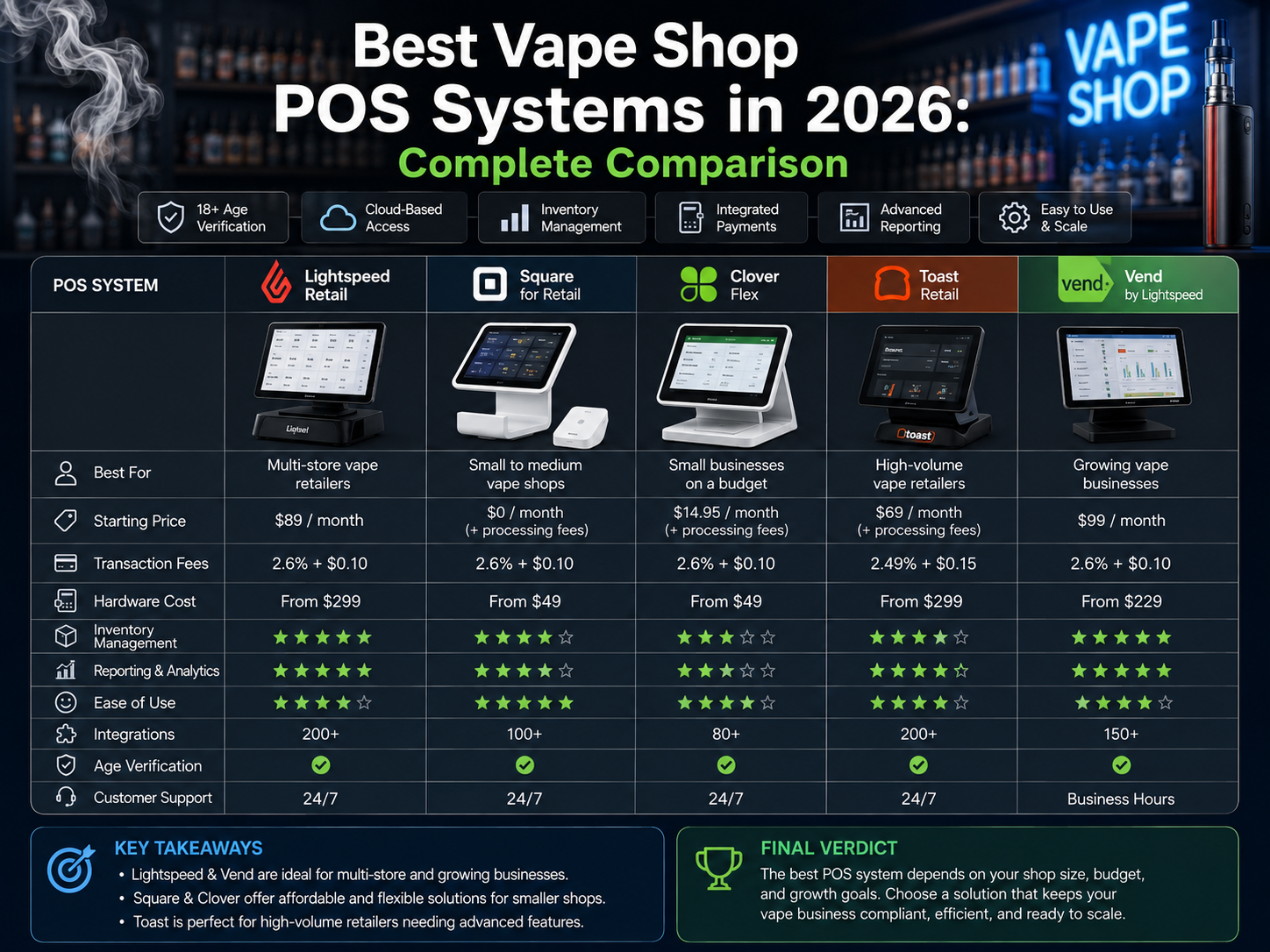
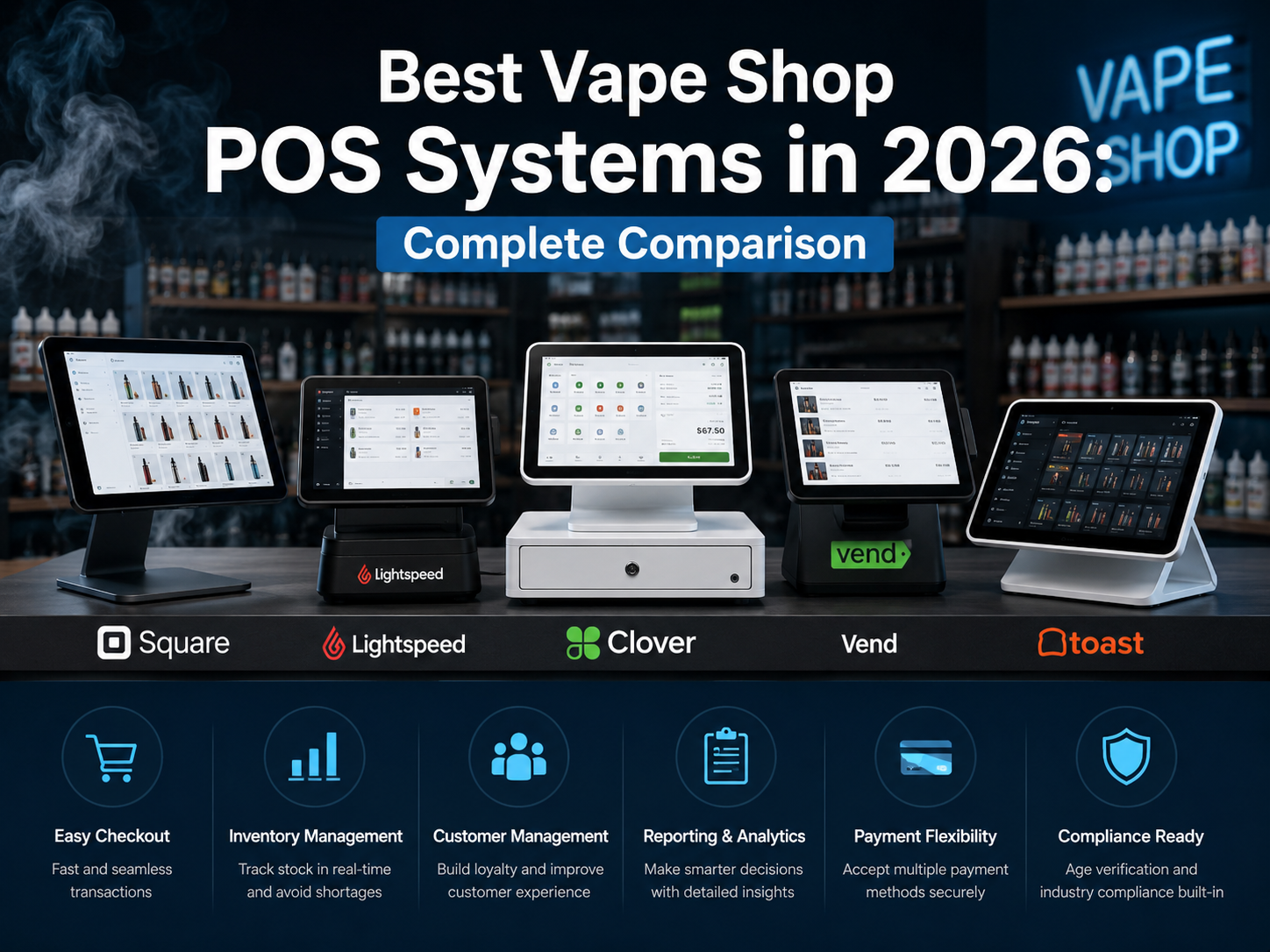
- #3 — Best Vape Shop POS Systems 2026 — Full comparison of Lightspeed, KORONA, Cova, POS Nation, Clover.
- #4 — Best Payment Processors for Vape Shops — High-risk processors, fees, reserves, and approval odds. (Coming soon)
- #5 — Best Age Verification Tools for Vape Ecommerce — Checkout age checks and delivery ID verification. (Coming soon)
- #6 — Best Ecommerce Platforms for Vape Stores — Shopify, WooCommerce, and vape-native platforms compared. (Coming soon)
- #7 — Vape Compliance Software Comparison — PACT Act and tax automation tools side by side. (Coming soon)
- #8 — How to Ship Vape Products Legally — Carrier rules, adult signature, and packaging requirements. (Coming soon)
- #9 — Lightspeed vs KORONA vs Clover — The three-way POS showdown. (Coming soon)
- #10 — WAAVE vs PayKings vs EMB — Payment processor head-to-head. (Coming soon)
- #11 — BlueCheck vs Veriff vs Yoti — Age verification tools compared. (Coming soon)
- #14 — Square for Vape Shops: Is It Safe? — Why Square terminates vape accounts — and what to use instead. (Coming soon)
- #16 — Cova POS vs POS Nation — Dispensary-grade vs. general retail, for vape. (Coming soon)
7. Frequently Asked Questions
How much does a vape shop tech stack cost per month?
A complete single-store stack runs roughly $330–480/month all-in at typical volume (software + processing fees + hardware amortization), plus shipping if you sell online. Online-only stores often start around $300/month in software but pay $8–20 per package in compliant shipping, which usually becomes the largest line item.
What POS system works with vape payment processors?
KORONA POS, Lightspeed Retail, Cova, and POS Nation all integrate with high-risk processors. KORONA is built specifically for age-restricted retailers and can bundle its own high-risk processing; Lightspeed requires pairing with a third-party high-risk gateway. Our POS comparison article covers integration compatibility for each system.
Do I need age verification software for a physical vape shop?
Yes. In-store, this means an ID scanner at the register (most vape-ready POS systems include it). Online, it means a checkout age check that verifies the buyer is 21+. For deliveries, the PACT Act requires age verification at the point of delivery with an adult signature. All three are separate touchpoints — one software tool can cover checkout and delivery, but the in-store scan is usually a POS feature.
Can I use Shopify or WooCommerce for a vape store?
You can build a vape store on either, but you cannot use their native payment processing (Shopify Payments and Stripe both prohibit vape). You'll add a high-risk gateway, a checkout age-verification app, and PACT-compliant shipping. Our ecommerce platforms guide walks through which platforms allow vape and how to configure them safely.