
Why competitor analysis matters for your brand
If you're building a vape brand, you can't afford to guess. Every product you put your name on is a promise about quality, safety, and performance. A solid competitor analysis tells you what's already on the market, how those products are made, and where the gaps are. It's not about copying—it's about finding your angle.
Take a moment to think about what you'd want to know before buying a device for your own use. Would you trust a label that says "premium" without any details on the coil material? Probably not. The same skepticism should guide your business decisions.
What early versions got wrong
Early vape products were a mess. Many had no user-replaceable parts, leaked constantly, and used materials that weren't food-grade. Some even had batteries that could fail dangerously. The market was full of products that looked great in a photo but fell apart in a week.
The biggest mistake was focusing on hype over reality. A flashy design meant nothing if the device burned out after 50 puffs. And because there wasn't much regulation, manufacturers could get away with inflated claims and low-quality parts.
That's why today's competitor analysis starts with the hard facts: who made it, what's inside, and does it actually work as described?
What modern versions fixed
Modern vape products, especially those from established brands, have improved a lot. You'll find consistent manufacturing, better quality control, and more transparent labeling. Some devices now come with replaceable coils, adjustable wattage, and even screens that show battery life and puff count.
Take the VERTEX-VISTA or LINQ-PRO, for example. These are products that put a lot of effort into build quality and user experience. They're not perfect—every product has trade-offs—but they're a far cry from the sketchy disposables that used to flood the market.
The good news is that this improvement makes your job as a brand owner easier. You can compare products on features that genuinely matter, like coil durability, battery life, and leak resistance, rather than just looks.
What still is not solved
Despite the progress, there are still big gaps. Let's be honest: the vape industry has a fake product problem. Counterfeit devices and e-liquids are everywhere, and they're getting harder to spot. Some fakes mimic popular brands almost perfectly, right down to the packaging.
Another issue is puff count inflation. Many products claim thousands of puffs, but real-world usage often falls short. That's not necessarily a lie—it's just that puff counts depend on draw length, voltage, and how you vape. But the gap between marketing and reality can be huge.
And then there's the regulatory side. The rules are constantly changing. What's legal in one country might be banned in another, and advertising restrictions are getting tighter. You need to stay on top of these because one misstep can cost you your business.
Buy for today, not nostalgia
When you're doing competitor analysis, don't get swayed by nostalgia or hype. Just because a product was popular three years ago doesn't mean it's still competitive. The market moves fast, and what was cutting-edge then might be outdated now.
Instead, focus on what works today: real performance, honest specs, and compliance with current regulations. For example, if you're looking at a device, check the battery capacity in milliamp-hours (mAh) and compare it to the actual power output. A 3000mAh battery might not be enough if the device runs at 80 watts.
Similarly, look at the coil material and resistance. Ceramic coils last longer but might not give the same flavor as mesh coils. That's a trade-off you need to weigh, not just a spec to list.
The same logic applies to e-liquids. Don't buy based on flavor name alone. Ask for the full ingredient list, including the base (PG/VG ratio), nicotine source, and any additives. Check for certifications like ISO or GMP compliance, and beware of products that won't share this information.
Finally, think about your distribution. A competitor analysis should include the supply chain. Who are the real manufacturers? Are they reliable? Can they meet your volume needs without sacrificing quality? The cheapest option isn't always the best if it means dealing with an unreliable supplier.
How to run your own analysis
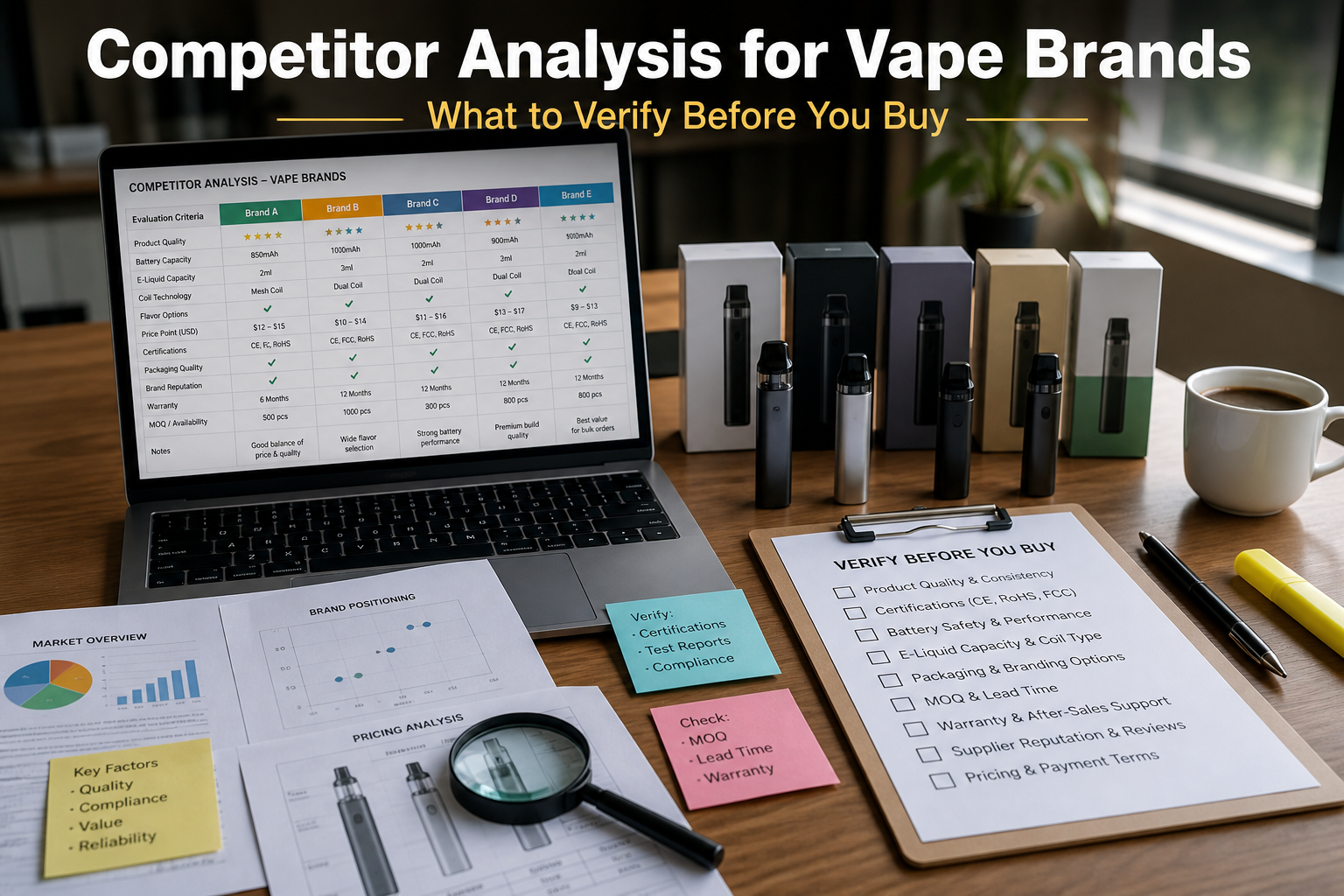
Here's a simple process you can follow:
- Step 1: Define your criteria. What matters to you? Price, quality, feature set, or compliance? Write these down.
- Step 2: Gather products. Pick 5 to 10 competitor products that fit your criteria. Include both popular and niche options.
- Step 3: Verify the basics. For each product, check who makes it, where it's made, and whether it has any certifications.
- Step 4: Test in the real world. If possible, use the products yourself. Track puffs, check for leaks, and note the build quality.
- Step 5: Compare side-by-side. Use a spreadsheet or a scorecard to rank them on each criterion. Be honest about your biases.
- Step 6: Look for gaps. Where are the weaknesses? Is there a need for better battery life, more flavor options, or safer materials? That's your opportunity.
Remember, the goal isn't to find a perfect product—it's to find what's missing and how you can fill that gap.
The role of regulation in competitor analysis
Regulation isn't just a legal checklist—it's part of your analysis. Products that don't comply with local laws are a liability, not an opportunity. Check things like age restrictions, packaging requirements, and advertising bans. The UK, for example, has strict rules on nicotine product labeling and advertising. You can read more about where you're allowed to vape in our guide on where you can vape in the UK, but the key is to know the rules before you commit.
Also, watch out for medical claims. You can't say a vape helps you quit smoking unless you have the evidence. Our article on medical cessation claim boundaries explains what you can and cannot say, and it's essential reading for any brand owner.
Final thoughts
Competitor analysis isn't a one-time task. It's an ongoing process that keeps your brand relevant and competitive. The more you know about the market, the better your decisions will be.
Start today: grab a few products, run them through the steps above, and see what you learn. It might surprise you.
This guide is for informational purposes only and not intended as legal or medical advice. Always follow local laws and regulations.
In this topic cluster
Related Windbar Guides
- Medical Cessation Claim Boundaries: What Your Vape Brand Cannot Say
- Housing Materials: Finish, Grip, and the Choices That Define Your Brand
Related Windbar Resources
- Vape Authenticity Checker — Helps verify if a product is genuine, which is a key step in competitor analysis.
- Vape Glossary — Quick reference for jargon like coil resistance and wattage when comparing specs.