
Why this happens
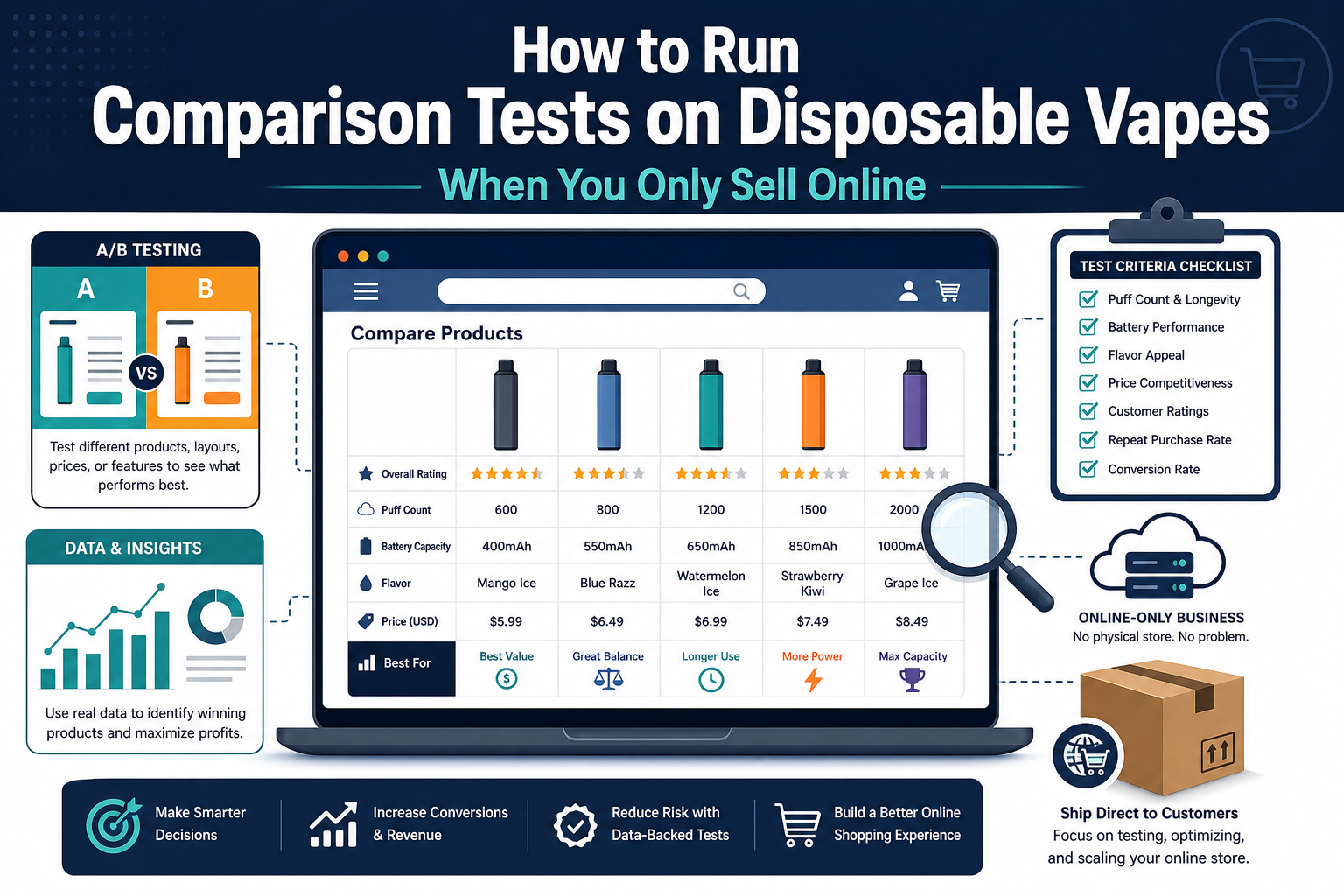
When you're behind the counter, the questions come fast: "Which one lasts longer?" "Does this one taste good?" "Is this easy to use?" Raw numbers don't answer those. You need to know if the device performs the same from the first puff to the last, if it's simple enough for a first-timer, if the flavor is clear and not muddy, if the battery matches the way the customer vapes, and if you can actually keep it in stock. That's the framework that works.
Criterion 1: Consistency
Consistency is the quiet killer of repeat sales. A device that hits well for the first fifty puffs and then fades is a disappointment, even if it's rated for thousands. As a staff member, you want a device that behaves predictably. How do you judge this without using every unit yourself? Ask your distributor for a sample or check batch quality. In the WINDBAR lineup, the VERTEX-VISTA and VERTEX-25K are built for consistent draw and flavor delivery, but you should test them yourself. A simple habit: when you open a new box, take one unit and use it for a day. Note if the flavor weakens or the draw gets tight. That's your baseline.
Criterion 2: Ease of Use
Disposables sell because they're simple. If a customer has to figure out airflow rings or button sequences, you've lost them. Look for devices that are draw-activated and require zero instruction. It sounds basic, but you'd be surprised how many devices complicate the experience. In the LINQ series, the LINQ-ONE is about as straightforward as it gets. For customers who want a bit more control, the LINQ-PRO offers adjustments without overwhelming. The rule: if you can't explain it in one sentence, it's not easy enough.
Criterion 3: Flavor Clarity
Flavor is subjective, but clarity isn't. A good flavor is distinct, not muddled. When you taste a device, ask yourself: can I tell what it's supposed to be? Does it stay clean throughout the puff? Some devices start strong and then get harsh. Others taste like a mix of everything. For retail staff, the practical approach is to know your lineup's flavor profiles. The AURA and VERTEX-15K have strong reputations for clear flavor, but again, taste them yourself. Keep a small notebook with your impressions—it's a reference you'll actually use.
Criterion 4: Battery Life
Battery life is about matching the device to the customer's habits. A heavy vaper needs a larger battery; a light user can get away with less. Don't push the biggest battery on everyone—that's a disservice. Look at the device's capacity and compare it to the puff count. If a device claims a high puff count but the battery drains first, that's a problem. The VERTEX-25K and VERTEX-15K are designed to balance battery and e-liquid, but verify for yourself. A quick test: charge one fully, use it for a day, and see where you end up.
Criterion 5: Availability
You can't sell what you can't stock. Availability is a retail reality that trumps everything else. If a device is constantly backordered, it doesn't matter how good it is. Check with your supplier on lead times and consistency of supply. The WINDBAR models are generally reliable, but it's worth asking. Also consider how many SKUs you want to carry. A deep lineup is good, but only if you can keep them all on the shelf. Sometimes a narrower selection with reliable stock is better than a wide range that's often empty.
How to weight them
The five criteria aren't equal for every customer. A first-time vaper cares more about ease of use and flavor clarity; a heavy user prioritizes battery life and consistency. Availability is always a factor, but it's more of a constraint than a preference. As a rule of thumb, weigh consistency at 30%, ease of use at 20%, flavor clarity at 20%, battery life at 20%, and availability at 10%. That's a starting point—adjust based on your store's customer mix. The point is to have a deliberate framework so you're not just pushing whatever's newest.
What to ignore
Ignore puff counts that sound too good to be true. Ignore marketing buzzwords like "cloud technology" or "premium feel." Focus on the five criteria and your own observations. Customers trust you when you can say, "This one's consistent, it tastes like X, and it'll last a heavy user a day and a half." That's more useful than any spec sheet.
Bottom line for the counter
Retail staff are the bridge between the product and the customer. Use this five-part framework to cut through the noise and recommend with confidence. Test the devices yourself, keep notes, and share what you learn with your team. That's how you build trust and repeat business. For more comparison insights, check out our guide on screen vs. no-screen devices, and join the community to swap observations with other retailers.