


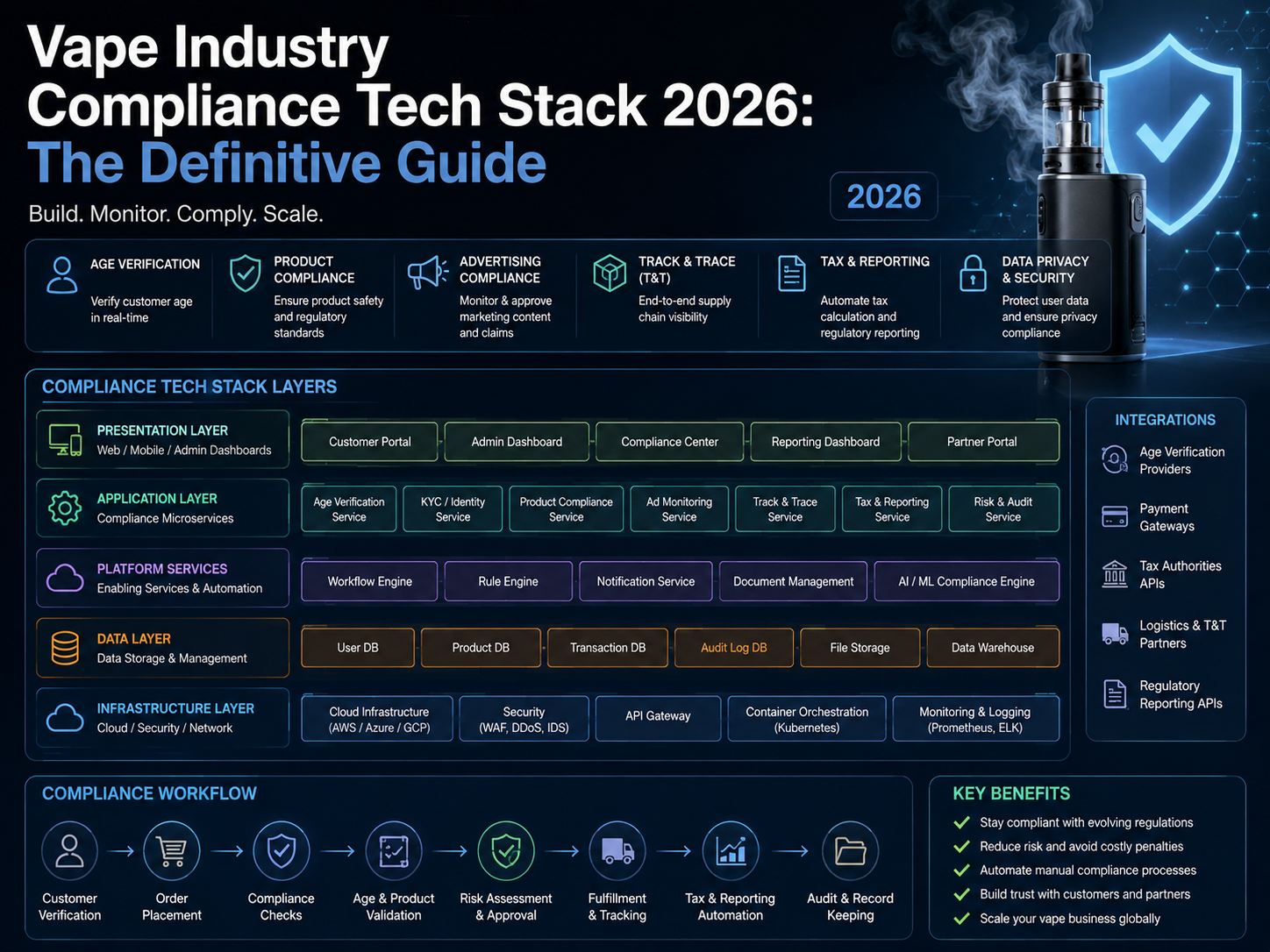
FDA, PACT Act, and 50 state rulebooks — the three layers of compliance every vape business faces, the software that automates each layer, and why one violation can cost more than a decade of tool subscriptions.
Updated Aug 2026 · ~24 min read · US market · 21+ only
Compliance is the most expensive line item most vape businesses never budget for — until it arrives as a fine. In 2026 the regulatory surface for vape is wider than ever: FDA enforcement on products, ATF and the PACT Act on sales and shipping, and a state-level patchwork that changes faster than most merchants can track. The good news: nearly every recurring obligation can be automated by a compliance tech stack that costs $100–600/month. This guide shows you exactly what that stack is, how to pick it, and why skipping it is the most expensive decision a vape business can make.
TL;DR — the 60-second version Three layers: FDA (product & retailer rules), PACT Act (shipping, registration, reporting), and state law (taxes, flavor bans, licenses). You must satisfy all three — simultaneously. Software automation: age verification tools, PACT Act/tax reporting software, and regulatory monitoring replace manual spreadsheets and missed deadlines. Cost math: a compliance stack runs ~$100–600/month; a single PACT Act or age-verification violation commonly costs $5,000–25,000+ with legal fees. Start here: register (FDA retailer + ATF PACT), then automate reporting, then set a monitoring calendar. Step-by-step in section 4.
1. The Three-Layer Compliance Architecture
Think of compliance as three stacked layers. Regulators don't care if you were "compliant with the other two" — each layer is enforced independently, and failure in any one can end the business.
Layer 1 — FDA: products and retailers
Applies to: every retailer, distributor, and brand selling tobacco/vape products in the US.
- Retailer registration: any business selling tobacco products must register with the FDA as a tobacco retailer.
- Product authorization: you may only sell products that have FDA marketing authorization (PMTA), a pending application, or grandfathered status. This list changes as enforcement evolves — products get denied and pulled from the market regularly.
- ID checks and signage: federal law requires age verification (21+) and prohibits vending-machine sales except in adult-only facilities.
- Enforcement: FDA issues warning letters and civil money penalties; repeated violations escalate to injunctions and retailer registration revocation.
Layer 2 — PACT Act: shipping, registration, reporting
Applies to: anyone who ships vape products to consumers or retailers.
- ATF registration: before shipping any vape products, you must register with the ATF under the Prevent All Cigarette Trafficking (PACT) Act.
- USPS ban: the US Postal Service is prohibited from delivering vape products. You must use private carriers (UPS, FedEx, and approved regional carriers) that have agreed to PACT Act compliance.
- Age verification at delivery: every shipment requires the recipient to be verified as 21+ and to provide an adult signature at the door.
- Tax collection & reporting: you must collect and remit applicable state and local excise taxes, and file recurring sales reports to each destination state — monthly or quarterly depending on volume thresholds.
Layer 3 — State law: the 50-rulebook problem
Applies to: every business, but the complexity explodes when you ship across state lines.
- Excise taxes: most states tax vape separately — some per-milliliter of e-liquid, some per milligram of nicotine, some as a flat percentage. Rates change yearly.
- Flavor bans: California, Massachusetts, New Jersey, New York, Rhode Island, Vermont, Washington, and others restrict or ban flavored vape products. A product that's legal in your state can be a violation in the state you ship to.
- Licensing: retailers need state tobacco/vape licenses; some states require separate online-seller licenses and registration in every destination state.
- Online and shipping bans: a growing number of states prohibit online vape sales outright or ban shipping into the state (e.g., New York's online-sale restrictions).
| Layer | Regulator | Core obligations | What software automates |
|---|---|---|---|
| 1 · FDA | FDA | Retailer registration; sell only authorized products; ID checks | Product-status tracking, record retention |
| 2 · PACT Act | ATF | Registration; age verify at delivery; tax collection; recurring reports | Report generation, deadline calendar, adult-signature workflows |
| 3 · State | State depts. of revenue/health | Excise & sales tax; flavor bans; licenses | Multi-state tax calculation, license renewal reminders |
The trap of "mostly compliant" A merchant who registers with ATF but uses USPS anyway, or verifies age at checkout but not at delivery, is still in violation. Each layer has its own inspectors, its own fines, and its own auditors. The compliance stack exists to close exactly these gaps — layer by layer, automatically.
2. Compliance Tool Selection Matrix
Five types of tools cover the recurring compliance workload. The matrix below maps each tool type to the layer it protects, what it automates, and what it costs.
| Tool type | What it automates | Layer | Cost range | Vendors |
|---|---|---|---|---|
| Age verification | Checkout age checks (database/KYC), delivery adult-signature capture, in-store ID scanning | FDA · PACT | $30–150/mo | BlueCheck, Veriff, Yoti, Token of Trust, Vapely |
| PACT Act reporting | Destination-state sales reports, excise tax calculation, filing deadlines, audit trails | PACT | $49–250/mo | Token of Trust, Vapely, Avalara |
| Tax automation | Multi-state sales tax rates & nexus monitoring, excise tax by product type | State | $49–200/mo | Avalara, Sovos, TaxJar-style tools |
| Regulatory monitoring | Track FDA action lists, flavor-ban changes, state law updates; flag SKUs that become illegal | FDA · State | $0–300/mo | Legal counsel + monitoring services; manual alerts |
| Document & record retention | Secure storage of age-verification logs, sales reports, licenses; organized for audit | All | $0–50/mo | Compliance-grade storage; POS-embedded logs |
2.1 Five questions to ask before you buy
- Which states does it cover? If you ship to 40 states, the tool must handle 40 state tax rules and report formats — not just your home state.
- Does it integrate with my checkout and POS? Age verification must fire inside your checkout flow; PACT reporting must pull order data automatically. Manual CSV uploads are a red flag.
- Does it cover delivery-age verification, or just checkout? The PACT Act requires verification at the door — some tools only do checkout checks.
- Does it generate the actual reports? The tool should produce the exact report format your destination states expect, and file or hand off on schedule.
- Is there an audit trail? When a regulator asks "show us your last 12 months of age-verification logs," the answer should be one export, not a scramble.
2.2 Example stack: online retailer (ship to 30+ states)
Highest reporting burden — needs the full matrix.
| Component | Cost |
|---|---|
| Checkout age verification | $80–150/mo |
| PACT Act + excise tax automation | $150–250/mo |
| Delivery adult-signature workflow | bundled w/ carrier |
| Regulatory monitoring / counsel retainer | $150–300/mo |
Total: $380–700/month — the price of shipping legally to most of the country
2.3 Example stack: single in-store retailer (no shipping)
Lighter stack — no PACT reporting if you never ship.
| Component | Cost |
|---|---|
| POS-embedded ID scanning | $0–30/mo |
| State sales tax automation | $0–50/mo |
| License renewal calendar | $0 (manual) |
Total: $0–80/month — but product-status (PMTA) tracking is still your responsibility
3. Cost of Non-Compliance vs. Tool Cost
Compliance software feels like overhead — until you price the alternative. Here's what violations actually cost, against what the equivalent tooling costs per month.
| Scenario | Typical consequence | Real-world anchor | Tool that prevents it |
|---|---|---|---|
| Selling to a minor in-store | $500–10,000+ / violation | State sting operations fine retailers five-figure amounts; repeat offenses trigger license loss | POS ID scanning ($0–30/mo) |
| Shipping without ATF registration | $10,000+ per incident | PACT Act violations carry steep statutory penalties per shipment | Registration checklist + PACT software ($49–250/mo) |
| No age verification on delivery | $1,000–10,000+ / package | Inspectors use test purchases on delivered packages | Adult-signature workflow (bundled w/ carrier) |
| Selling a flavor-banned SKU | Inventory seizure + fines | State AGs confiscate banned inventory and fine retailers | Regulatory monitoring ($0–300/mo) |
| Missed excise tax remittance | Back taxes + interest + penalties | States audit merchants and assess penalties on top of owed taxes | Tax automation ($49–200/mo) |
| FDA product-safety violation | Warning letter → fines → registration revocation | FDA has issued thousands of warning letters to vape retailers and distributors since 2020 | Product-status tracking |
The math that matters One $5,000 fine is the equivalent of ~14–40 months of a mid-range compliance stack. And fines compound: legal counsel, pulled inventory, processor consequences, and lost sales while you sort it out. Compliance software isn't a cost center — it's insurance with a predictable premium.
4. How to Build Your Compliance Stack in 5 Steps
- Map your exposure. Write down: do you sell in-store, online, or both? Do you ship, and to which states? How many locations? Your answers determine which layers apply. In-store only = FDA + state. Shipping = FDA + PACT + state.
- Register everything. FDA tobacco retailer registration; ATF PACT Act registration (before the first shipment); state licenses in every state you operate or ship to. Our step-by-step PACT registration guide walks through the ATF process.
- Automate age verification. In-store: POS ID scanning. Online: checkout age check that verifies 21+ against databases/KYC. Shipping: adult-signature at delivery. One vendor can often cover checkout + delivery; in-store is usually a POS feature.
- Automate tax & PACT reporting. Choose PACT Act software that pulls order data from your checkout, calculates excise/sales tax per destination state, and generates the reports on schedule. Set the calendar once; let it remind you.
- Set a monitoring rhythm. Monthly: reconcile reports. Quarterly: review state law changes and FDA action lists. Yearly: re-verify every SKU's PMTA status and renew every license. A compliance calendar is the cheapest tool you own.
Common mistakes to avoid Using USPS for vape shipments (banned — carries statutory penalties), treating age verification as a checkout-only feature (delivery matters), ignoring flavor bans in destination states, and assuming your processor handles PACT reporting (it doesn't). For the full list, see our "10 vape compliance mistakes that will get you fined" checklist.
5. Frequently Asked Questions
Do I need PACT Act registration if I only sell in-store?
If you never ship vape products — no delivery, no mail order — the PACT Act's shipping and reporting obligations generally don't apply to you. You still need FDA retailer registration and state licenses. The moment you ship anything, even a single package to a friend's house, registration and age-verification-at-delivery obligations kick in.
What software handles PACT Act reporting?
Tools like Token of Trust and Vapely offer PACT Act reporting and age-verification services for vape businesses; Avalara and similar tax platforms handle multi-state sales/excise tax. The key requirement is integration — the tool should pull order data from your checkout automatically and generate the reports your destination states expect. Our compliance software comparison reviews these side by side.
Is age verification software legally required?
Yes in effect: federal law requires age verification of 21+ for vape sales, and the PACT Act adds age verification at delivery with adult signature. While the law doesn't name a specific software product, a database-backed age check at checkout and ID verification at delivery are how merchants demonstrate compliance. Manual "click to confirm you're 21+" buttons do not satisfy regulators.
Can I be compliant and still use Shopify or WooCommerce?
Yes — the platform isn't the problem, the configuration is. You need a checkout age-verification integration, a high-risk payment gateway (Shopify Payments and Stripe prohibit vape), PACT-compliant shipping, and tax automation. It's more assembly than with a vape-native stack, but it works if done completely. See our ecommerce platforms guide for the setup.
How much does a compliance tech stack cost?
In-store only: $0–80/month. Shipping to a few states: roughly $100–300/month. Shipping nationwide (30+ states): $380–700/month including monitoring and reporting automation. Compare that to a single $5,000+ fine and the ROI answers itself.
6. Related Guides
- #1 — Vape Shop Tech Stack: The Complete 2026 Guide — The full six-layer stack and cost calculator — start here for the big picture.
- #3 — Best Vape Shop POS Systems 2026 — POS systems with built-in ID scanning and compliance features.
- #7 — Vape Compliance Software Comparison — PACT Act and tax automation tools side by side. (Coming soon)
- #13 — Token of Trust vs Vapely — Age verification + PACT reporting head-to-head. (Coming soon)
- #22 — How to Register for PACT Act: Step-by-Step — The ATF registration walkthrough. (Coming soon)
- #27 — 10 Vape Compliance Mistakes That Will Get You Fined — The violation checklist every operator should read. (Coming soon)