
When Calculus Swept Through the Red Sorghum Fields
A satirical WINDBAR short story about vape culture, consumerism, money, and the mathematics of human desire.
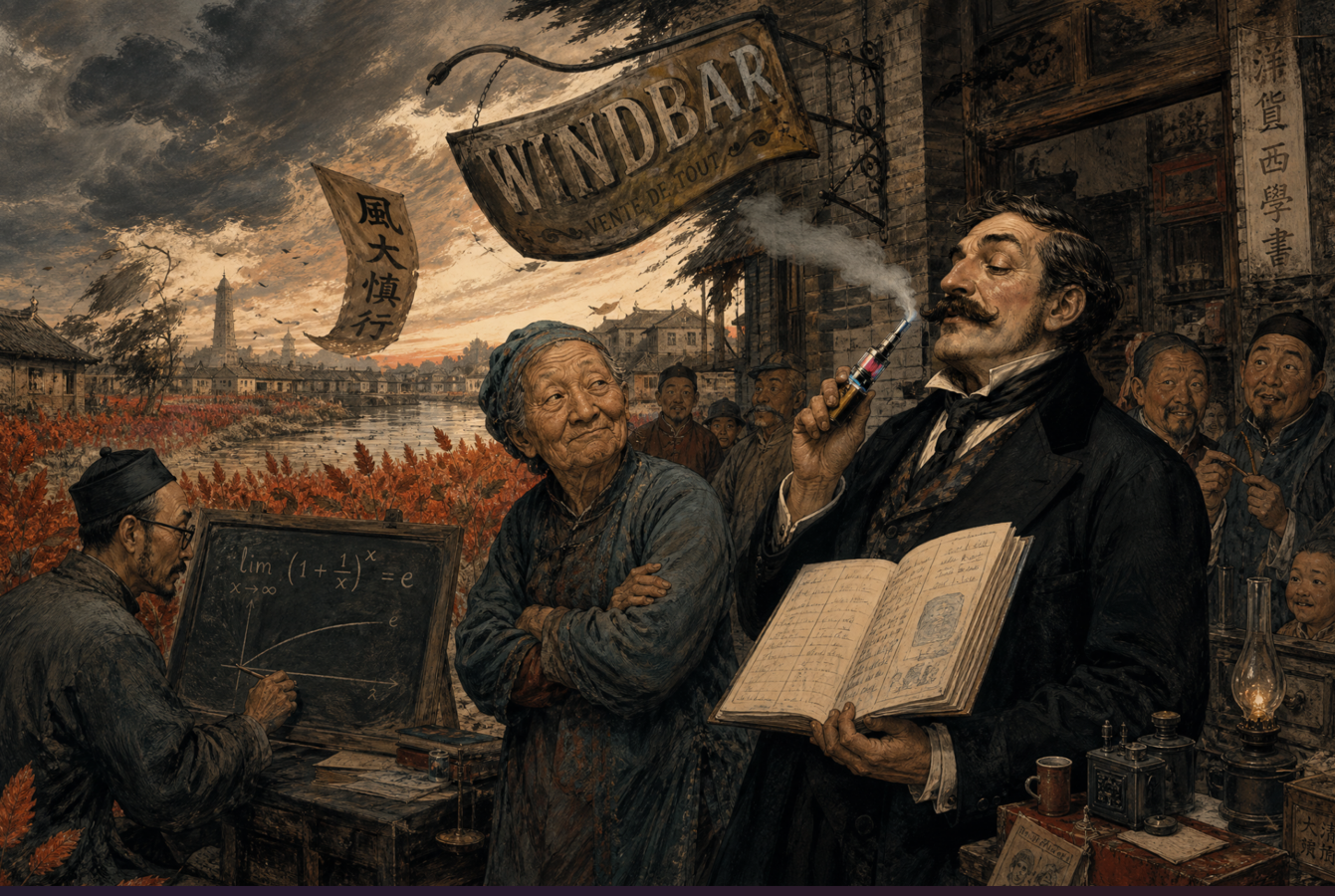
The wind had been blowing for seven days straight at the eastern end of the village. It bent the red sorghum in every direction and twisted the WINDBAR sign above the shop into a complicated spatial curve.
Old Sun crouched on the doorstep and studied it for a long time.
"That," he announced solemnly, "is a hyperbola."
"No," I said. "One of the screws has come loose."
Old Sun refused to accept such a vulgar explanation. In his youth, he had studied advanced mathematics for three months. Although he had long since returned everything he knew about calculus to his teacher, he remained convinced that all things under heaven could be explained with formulas.
A fall in grain prices was a negative derivative. An increase in drinking capacity was a positive derivative. A debt that was never repaid was an infinite series. And whenever the village chief held a meeting without getting to the point, the limit of the function simply did not exist.
A Merchant, a Ledger, and a WINDBAR
One day, a French merchant in a black wool coat arrived from town. His nose resembled a silver coin polished by compound interest, and his eyes held the lights of every pawnshop in Paris.
He introduced himself as Monsieur Balzac.
"I have traveled across the human world," he said, "to study two questions: how people become rich, and how they become corrupted afterward."
He picked up a WINDBAR device, turned it over in his hands, and asked:
"Can this bring happiness?"
"Happiness is difficult to measure," Old Sun replied, "but the flavors can be selected."
The Frenchman immediately opened his ledger. First, he calculated the cost. Then he calculated the profit. Finally, he calculated human vanity.
He discovered that costs and profits were finite quantities, while vanity approached infinity.
A smile appeared on his face, the particular smile worn by a capitalist who has just discovered a new continent.
"Gentlemen," he declared, "a product is never merely a product. What is truly being sold is the way a person wishes to be seen by others."
Vape Culture and the Price of Being Seen
The villagers fell silent.
The blacksmith lowered his hammer. The butcher lowered his knife. Even the mathematics teacher put aside the integral he had been unable to solve for three days.
Only my grandmother remained unimpressed.
She was eighty-seven years old and had survived bandits, famine, harvests, weddings, and more price increases than anyone could count. She glanced at the Frenchman and said:
"Why make it sound so mysterious? You're just doing business."
Monsieur Balzac fell silent.
He had written about countless clever men, but never before had he encountered a woman capable of compressing the entire Human Comedy into a single sentence.
The Calculus of Wealth and Desire
To recover his dignity, the Frenchman turned to the blackboard and wrote:
lim(x→∞) Desire / Income = ?
"Debt," Old Sun answered immediately.
"Insufficient information," said the mathematics teacher.
"It means you can't sleep at night," said my grandmother.
The wind passed through the sorghum fields once more. The WINDBAR sign trembled above the shop like an answer that had not yet been calculated.
The Frenchman looked at the villagers. The villagers looked at the mathematics teacher. The mathematics teacher looked at the blackboard.
The limit never appeared.
What Consumerism Cannot Calculate
The Frenchman eventually left the village carrying a case of products, three account books, and my grandmother's remark.
It was said that he returned to Paris and made a great fortune. Yet he continued to wake in the middle of the night, because he had finally understood something:
Wealth can be added. Desire can be differentiated. But life is not necessarily continuous.
As for Old Sun, he fastened the sign with a piece of iron wire and never again called it a hyperbola.
Instead, he said it was WINDBAR's asymptote in the real world:
A person may move infinitely closer to the life they desire, but before they can reach it, they must first tighten the loose screws.
Questions About the Story
What is this WINDBAR story about?
The story uses WINDBAR, village life, and advanced mathematics to explore vape culture, consumerism, social status, and the gap between income and human desire.
How does the story use calculus as a metaphor?
Derivatives, limits, infinite series, and asymptotes turn everyday problems into mathematical jokes. They also show how wealth may be measurable while vanity and desire continue to grow.
Why does the story combine rural China with a French merchant?
The cultural contrast creates an East-meets-West satire. The merchant analyzes profit and ambition, while the grandmother reduces his theory to a practical truth about business and human behavior.
Is the story promoting vaping as a source of happiness?
No. The product is a narrative symbol in a fictional examination of branding and consumer culture. The story does not make health claims or suggest that vaping produces happiness or improves a person's life.
Publishing Notes
- Intended for audiences of legal vaping age only.
- Add the final production domain to the canonical field before publishing.
- Use an age gate where required by local law or platform policy.
- Do not add health, wellness, smoking-cessation, or lifestyle-improvement claims.
- Keep the keyword strategy in metadata and natural prose rather than adding a visible keyword list.