
What the claim usually means
Every age verification API promises to "verify age" and "keep you compliant." But those claims are broad. What they really mean depends on the method:
- ID scan: The customer takes a photo of their ID, and the API checks it against fraud databases. This is the most accurate but requires a physical ID.
- Database check: The API queries public records (voter rolls, utility data) to confirm age. Faster, but can fail for people with thin data files.
- Age estimation: Uses AI to guess age from a selfie. Convenient but controversial—accuracy varies, and some states don't accept it as sole proof.
When a vendor says "99% accuracy," ask what they mean. Accuracy at what? Across all methods? For database checks, that might just mean the check completed without error, not that it correctly verified the person.
What to find on the label
Look for concrete details in the API's documentation or product page:
- Verification methods offered: Does it do ID scan? Database check? Both? Can you switch?
- Compliance coverage: Does it handle your state's specific requirements? For example, Texas requires a database check before selling vape products online. If the API doesn't mention state-specific rules, that's a red flag.
- Integration options: Is there a plugin for Shopify, WooCommerce, or your custom site? How much dev work is needed?
- Pricing transparency: Per-check? Monthly? Are there setup fees? What about overage charges?
- Audit logs: Can you export a log of every verification? This is essential for your own compliance records.
- Data retention: How long does the API keep customer data? Where is it stored?
Gaps between claim and label
Here's where claims fall short:
- "Compliant" doesn't mean certified. Some vendors say they're "compliant with all state laws," but they can't point to a specific certification. Ask for a compliance attestation or legal opinion.
- "AI" is vague. Age estimation using AI sounds impressive, but if the vendor can't explain how they measure accuracy or what threshold they use, be skeptical.
- "Easy integration" can hide hours of work. A plugin might take minutes, but custom APIs could need a developer. Ask for a time estimate.
- Pricing can balloon. Per-check pricing seems low, but if you have thousands of transactions, it adds up. Watch for minimum monthly commitments or fees for additional checks.
Questions to ask the seller
Before you sign up, ask these:
- Which verification methods do you support, and can I choose which one to use?
- Do you cover my state's specific age verification requirements? Can you show me documentation?
- What does your audit log include, and can I export it?
- How long do you store customer data, and where?
- What is your accuracy rate for each method, and how do you measure it?
- Are there any hidden fees—setup, integration, overage, or data storage?
- Can I do a free trial or test sandbox?
- Do you have a compliance attestation or third-party audit?
When to walk away
Skip any vendor that:
- Can't explain their verification methods in plain language.
- Has no audit log feature.
- Won't give a straight answer on pricing.
- Claims to be "fully compliant" but can't cite specific laws.
- Requires a long-term contract without a trial.
- Has no customer support or documentation.
Remember, age verification isn't just a feature—it's your legal obligation. If a tool feels sketchy, it probably is.
Bottom line
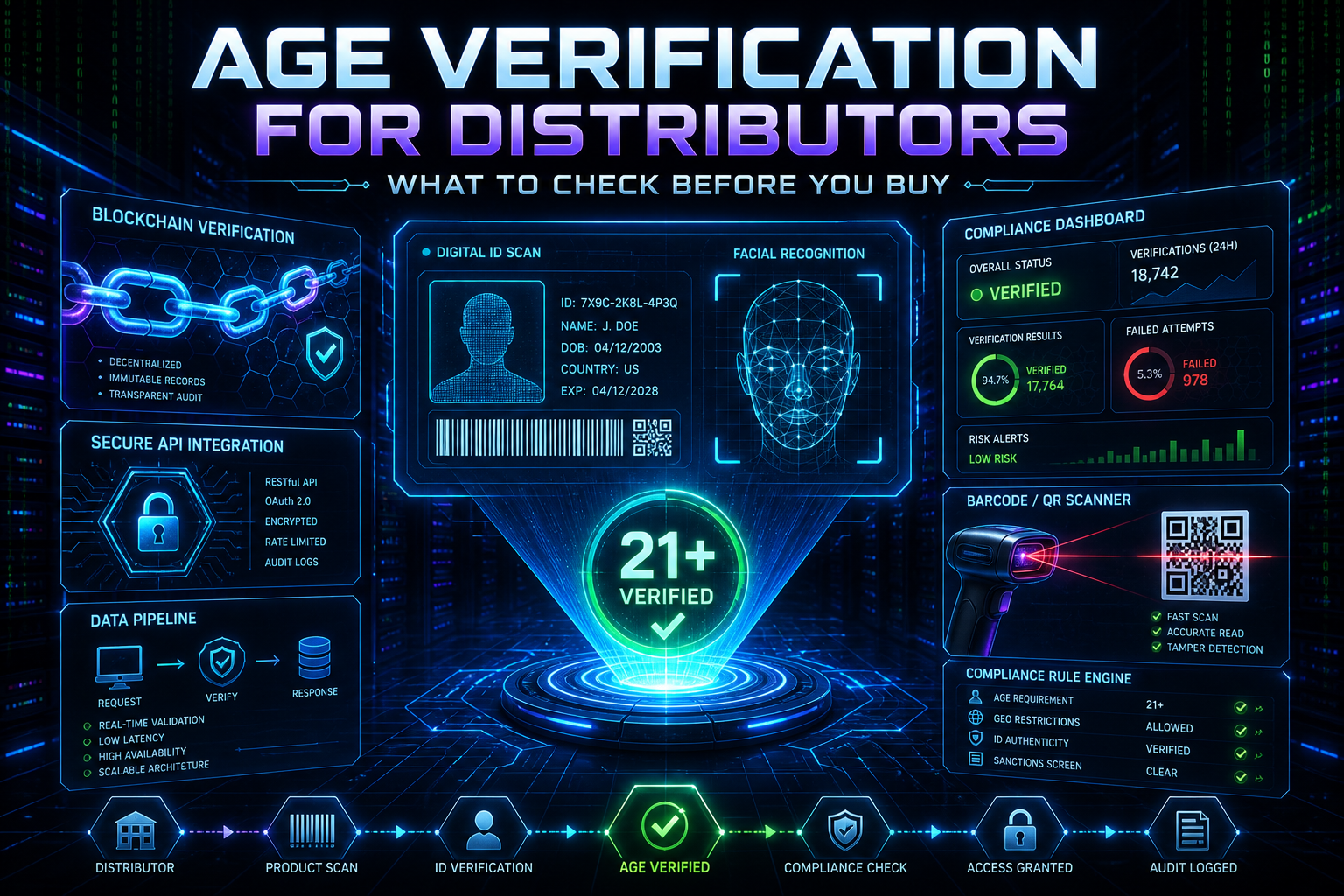
Choosing an age verification API is about matching your shop's needs—volume, state requirements, and user experience—to the right tool. Don't be swayed by buzzwords. Do your homework, test, and ask hard questions. For more on compliance, check out our guide on Cross-Checking Texas Online Vape Sales Restrictions. And if you're just starting, our Age Verification for Distributors guide is a good next read.
Read before buy
- Choosing an age verification API for a vape shop isn't just about checking a box. You need to compare verification methods, compliance coverage, integration effort, and pricing structure. Look for transparent pricing, robust audit logs, and a provider that can attest to compliance with state and federal rules. Avoid vague claims about AI and hidden fees.
- Verify the verification methods: ID scan, database check, or age estimation—each has different accuracy and user friction.
- Check compliance coverage: does the API handle your state's specific requirements (e.g., Texas database check)?
- Understand pricing: per-check, monthly, or hybrid—and watch for hidden integration or overage fees.
- Demand audit logs: you need a record of each verification for compliance audits.
- Test before you commit: use free trials and ask for a compliance attestation.
In this topic cluster
- Age Verification articles
- Cross-Checking Texas Online Vape Sales Restrictions: A Verification Guide for E-Commerce Operators
- Age Verification for Distributors: What to Check Before You Buy
- Age Verification in Ohio: What Collectors Should Verify Before Buying CBD Vaporizers